

Every business wants more customers, but generating leads is only one part of the sales process. The real challenge is identifying genuine prospects, understanding their requirements, following up at the right time, and converting them into paying customers.
This is where businesses often compare AI Lead Management vs Traditional CRM.
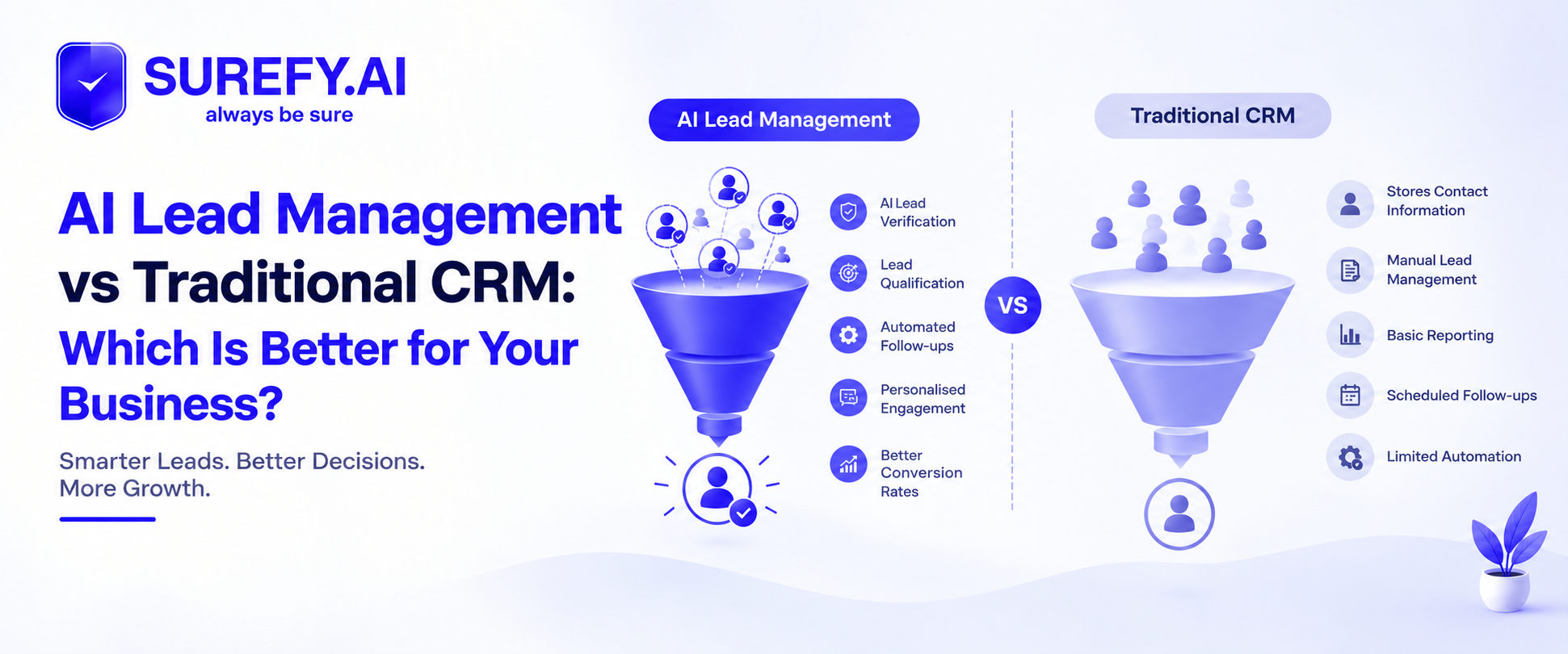
Traditional Customer Relationship Management (CRM) systems help businesses organise customer information, track interactions, manage sales pipelines, and maintain records. They provide a structured way to manage customer relationships. However, many traditional CRM workflows still depend on employees to verify lead details, assess lead quality, prioritise prospects, and decide what action to take next.
An AI Lead Management Platform adds another layer of intelligence to this process. Depending on its capabilities, it can help businesses validate customer information, identify promising leads, automate repetitive tasks, and support more timely, personalised engagement.
The difference is not simply about using newer technology. It is about moving from manually managing lead records towards making better, data-informed decisions throughout the sales journey.
In this guide, we will explore the differences between AI lead management and traditional CRM, their advantages and limitations, and how to choose the right solution for your business.
What is Traditional CRM?
A traditional CRM is software that helps businesses store, organise, and manage customer and prospect information in one place.
Sales and marketing teams use CRM systems to maintain contact details, record conversations, monitor sales opportunities, schedule follow-ups, and track progress through the sales pipeline.
For example, when a prospective customer fills out a website form, the CRM can store their name, phone number, email address, company details, and enquiry. A sales representative can then contact the prospect, record the conversation, and update the lead’s status.
Key features of traditional CRM
- Contact management: Stores customer and prospect information.
- Sales pipeline tracking: Shows where each prospect stands in the sales process.
- Task and reminder management: Helps sales representatives remember follow-ups.
- Interaction history: Records calls, emails, meetings, and other customer interactions.
- Reporting and analytics: Provides visibility into sales activities and performance.
- Workflow automation: Automates predefined tasks, depending on the CRM’s features.
Traditional CRM remains useful for businesses that need organised records, consistent sales processes, and a centralised view of customer relationships. Many modern CRMs also offer AI features, so the distinction is not that all traditional CRMs lack AI. The key question is how deeply intelligence is integrated into lead verification, prioritisation, and action.
What is AI Lead Management?
AI Lead Management uses artificial intelligence, automation, and data analysis to help businesses manage leads more intelligently across different stages of the sales funnel.
Instead of simply storing prospect information, an AI-powered system can assist with understanding lead quality, identifying missing or inconsistent information, prioritising prospects, and recommending suitable next steps.
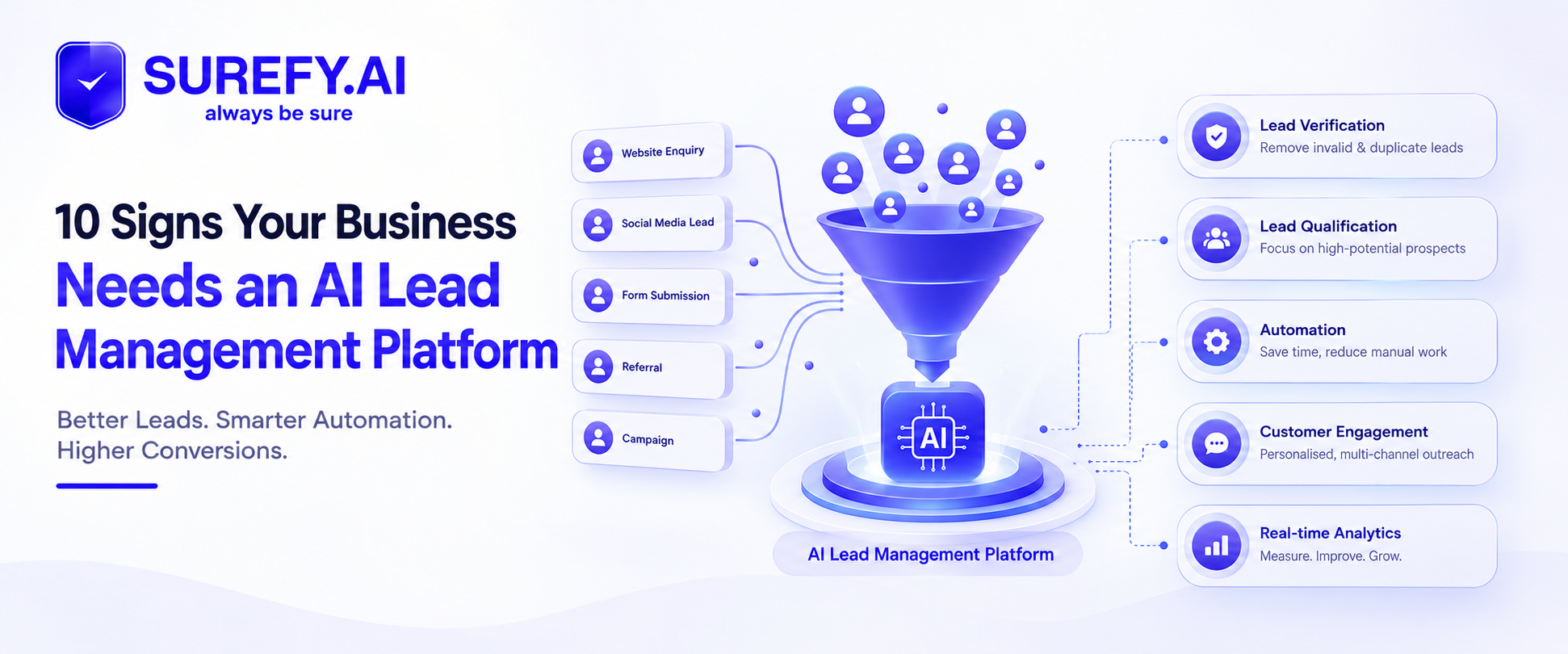
An AI Lead Management Software solution may support several stages of the lead lifecycle, from lead capture and verification to qualification, nurturing, sales engagement, and conversion.
For instance, imagine a business receives 500 enquiries through its website, advertising campaigns, and WhatsApp. The sales team cannot realistically give every enquiry the same level of attention.
An AI-powered system can help organise these leads, flag incomplete records, apply qualification criteria, and prioritise prospects who appear more likely to convert. Sales representatives can then focus their efforts where they are most needed.
Key features of AI lead management
- AI Lead Verification: Helps identify potentially invalid, incomplete, or inconsistent lead information.
- Automated lead qualification: Evaluates prospects against predefined business rules and relevant data.
- Lead prioritisation: Helps sales teams focus on prospects with stronger engagement or higher qualification scores.
- AI Sales Automation: Supports repetitive sales activities, reminders, and follow-up workflows.
- Customer data analysis: Helps identify patterns in lead behaviour and campaign performance.
- Personalised engagement: Supports more relevant communication based on available customer information and preferences.
The precise capabilities depend on the platform, integrations, data quality, and configuration. AI can support decisions, but businesses should still define their qualification criteria and review important decisions appropriately.
AI Lead Management vs Traditional CRM: Key Differences
The main difference is how each approach helps a business move from collecting customer information to taking meaningful sales action.
A traditional CRM primarily provides a system for managing customer relationships and sales activities. AI lead management focuses on using intelligence and automation to improve how leads are assessed, prioritised, and handled.
| Feature | Traditional CRM | AI Lead Management |
|---|---|---|
| Lead storage | Organises contact records | Organises records and may enrich analysis using available data |
| Lead verification | Often requires manual checks or integrations | Can help flag invalid or inconsistent information |
| Lead qualification | Frequently relies on manual rules and sales judgement | Can assist with scoring and prioritisation using configured criteria |
| Follow-ups | Tasks, reminders, and predefined workflows | Can support automated, context-aware follow-up workflows |
| Lead prioritisation | Often based on pipeline stages or manually assigned scores | Can use multiple available signals to recommend priority |
| Data analysis | Reports on sales activities and outcomes | May identify patterns and trends to support decisions |
| Campaign management | Tracks campaign activities, depending on features | Can help tailor workflows and engagement using available data |
| Sales productivity | Improves organisation and visibility | Can reduce selected manual tasks and help focus sales effort |
| Decision-making | Relies heavily on users interpreting records and reports | Combines human judgement with AI-assisted insights |
| Best suited for | Structured contact and relationship management | Businesses seeking more intelligent lead handling and automation |
Note: These are general differences, not universal rules. Modern CRM platforms increasingly offer AI scoring, data enrichment, automated workflows, and predictive analytics.
7 Major Differences Explained
1. Manual Lead Handling vs Intelligent Lead Processing
Traditional CRM makes it easier to organise incoming enquiries. However, a sales representative may still need to check contact information, review the prospect’s requirements, and decide which leads deserve immediate attention.
An AI Lead Management Platform can help streamline these steps by analysing available information and applying predefined qualification criteria.
For example, a software company receiving enquiries from multiple industries might prioritise prospects based on company size, business requirements, engagement, and purchase readiness.
This can help sales teams spend less time sorting through records and more time having meaningful conversations with potential customers.
2. Basic Contact Records vs AI Lead Verification
A lead record is only as useful as the information it contains.
Incorrect phone numbers, invalid email addresses, duplicate entries, and incomplete customer details can waste sales resources and affect campaign performance.
Traditional CRM systems can store these details and may support validation through integrations. However, verification often requires additional tools or manual processes.
An AI Lead Verification Platform can help identify suspicious patterns, inconsistencies, and missing information. When combined with reliable validation services, it can support better-quality lead records.
Businesses may also use a Customer Data Verification Platform to check customer information against appropriate data sources, subject to consent, permissions, and applicable privacy requirements.
Importantly, verification does not automatically prove that a person is interested in buying. A valid contact and a qualified prospect are two different things.
3. Manual Qualification vs Data-Assisted Lead Scoring
Traditional CRM systems allow sales teams to assign lead statuses, record notes, and apply scoring rules. These methods can work well when the sales process is straightforward.
However, when lead volumes grow, manually reviewing every enquiry becomes difficult.
Lead Qualification Software can help evaluate prospects using criteria such as:
- The prospect’s stated business requirements.
- Company or industry fit.
- Engagement with relevant campaigns.
- Previous interactions with the sales team.
- Budget, authority, and purchase timeline, when this information is appropriately collected.
AI-assisted scoring can help sales teams identify leads that deserve closer attention. Its effectiveness depends on the quality of the data and how well the scoring model reflects actual sales outcomes.
AI recommendations should be reviewed and improved over time rather than treated as guaranteed predictions of conversion.
4. Scheduled Follow-Ups vs AI Sales Automation
Follow-up timing can make a significant difference to sales performance. A promising prospect may lose interest if the response is delayed, while excessive communication can damage the customer experience.
Traditional CRM systems commonly provide reminders, task assignments, and predefined automated sequences.
AI Sales Automation can build on these workflows by helping teams determine which action to take, when to follow up, or which message may be relevant, depending on the platform’s capabilities.
For example, a prospect who requests a product demonstration might receive an immediate acknowledgement, followed by a reminder for the assigned sales representative. Another prospect who is still researching may enter a relevant educational communication sequence.
Automation should remain transparent, respect communication preferences, and provide appropriate options to stop unwanted messages.
5. Standard Campaigns vs More Relevant Customer Engagement
Marketing campaigns often generate leads across multiple channels. Without proper coordination, customers may receive irrelevant messages or repeated communications from different teams.
A Customer Engagement Platform can help businesses coordinate interactions across supported channels, such as email, SMS, voice, and WhatsApp.
When connected to lead management workflows, it can support more relevant communication based on the customer’s interests, stage in the sales journey, and previous interactions.
Similarly, Campaign Management Software helps teams plan, execute, and monitor campaigns. AI capabilities may improve audience segmentation, message recommendations, and campaign analysis.
The objective is not to send more messages. It is to make each interaction more useful and timely.
6. Historical Reporting vs Actionable Insights
Traditional CRM reports can show the number of leads generated, sales activities completed, deals won, and opportunities lost.
These reports help businesses understand what has happened.
AI-assisted analytics may go further by identifying patterns in lead quality, campaign outcomes, or customer behaviour. For example, a business might discover that enquiries from a particular campaign generate high lead volumes but few qualified opportunities.
This insight can help the marketing team reconsider targeting, messaging, or budget allocation.
An AI Marketing Platform may combine these insights with campaign automation and audience analysis, depending on its features and integrations.
The value comes from using data to make better decisions, not simply producing more reports.
7. Managing More Leads vs Improving Lead Quality
Generating more leads does not necessarily mean generating more sales.
If a business attracts hundreds of enquiries but many contain incorrect information or have little relevance to its offering, the sales team may struggle to convert them.
Verified Lead Generation focuses on improving the reliability of lead information and reducing avoidable data-quality problems. When combined with qualification and nurturing, it can help businesses make better use of their marketing efforts.
A Verified Lead Generation Platform may bring together lead capture, validation, qualification, and workflow automation. However, the exact scope varies by provider.
The goal should be to measure more than the number of leads collected. Businesses should also track qualified leads, sales acceptance, conversion rates, acquisition costs, and revenue.
Benefits of an AI Lead Management Platform for Growing Businesses
For MSMEs, startups, and expanding sales teams, managing leads manually can become increasingly challenging as campaigns and customer enquiries grow.
An AI-powered approach can offer several practical benefits when implemented correctly.
Better use of sales time
Automating repetitive administrative tasks can give sales representatives more time to understand customer requirements, answer questions, and build relationships.
Improved data quality
AI-assisted checks and validation integrations can help teams detect incomplete, duplicate, or inconsistent records before those records move further into the sales process.
Faster lead prioritisation
Lead scoring and prioritisation can help teams decide which enquiries to review first, especially when lead volumes are high.
More consistent follow-ups
Automated workflows can reduce missed reminders and help ensure that prospects receive timely responses.
More relevant customer communication
Combining customer information with engagement workflows can help businesses deliver communications that better match each prospect’s needs.
Greater visibility into marketing performance
By connecting lead quality with campaign results, businesses can evaluate which channels contribute to meaningful sales opportunities rather than focusing solely on enquiry volume.
These benefits are not automatic. Results depend on implementation, staff adoption, integration quality, data accuracy, and regular performance measurement.
Where Do Business Verification APIs and Customer Data Validation Fit In?
Lead management is not only about scoring and follow-ups. In many industries, businesses also need to establish whether submitted information is accurate and whether a customer or business meets specific verification requirements.
This is where verification tools and APIs can play an important role.
Business Verification API
A Business Verification API allows an application to request business-related verification data from a supported external service. Depending on the provider and jurisdiction, it may help check selected business identifiers, registration details, or other permitted information.
For businesses serving other businesses, this can help reduce manual verification work and support more consistent onboarding processes.
Digital Customer Verification
Digital Customer Verification involves verifying customer information through digital processes. Depending on the use case, this may include contact validation, identity verification, or checks against authorised records.
A Customer Verification Platform can help coordinate relevant verification steps, while a Lead Verification Software solution may focus specifically on assessing the reliability of information collected through lead-generation channels.
These functions are related, but they are not interchangeable. Validating a phone number is different from confirming someone’s identity, and neither automatically establishes purchase intent.
Customer Data Validation
Customer Data Validation helps businesses check whether information meets specified requirements and is consistent with expected formats or authorised reference sources.
When verification is integrated into lead management, teams can potentially detect data-quality issues earlier, improve record consistency, and reduce unnecessary manual checks.
Businesses should choose verification services that match their actual requirements, provide appropriate safeguards for personal data, and comply with applicable Indian data-protection and sector-specific regulations.
Can AI Lead Management Replace Traditional CRM?
Not necessarily. In many businesses, the strongest approach is to combine CRM capabilities with AI-powered lead management.
Traditional CRM remains valuable for maintaining customer histories, managing sales pipelines, recording conversations, and coordinating teams. AI lead management can complement these capabilities through data analysis, verification workflows, qualification support, and automation.
Consider a business that receives leads through its website, paid advertising, and WhatsApp.
Its CRM may store the enquiries and track their sales progress. An AI-powered lead management layer could help identify duplicate records, flag incomplete information, score leads against agreed criteria, and recommend the next follow-up action.
The sales representative can then review the available information, contact the prospect, and make the final decision.
This combination allows businesses to preserve the structure of CRM while improving selected parts of the lead lifecycle.
Before investing in a separate solution, businesses should check whether their existing CRM already offers the AI features they need. A new platform is worthwhile when it fills a genuine gap, integrates reliably, and delivers measurable business value.
How to Choose the Right Solution for Your Business
The right solution depends on your lead volume, sales process, data requirements, team size, and business objectives.
Traditional CRM may be sufficient if:
- Your main requirement is organising customer records and sales opportunities.
- Your lead volume is manageable with existing workflows.
- Your sales team prefers manual qualification and direct control over follow-ups.
- Your current reporting and automation features meet your needs.Consider AI lead management if:
- Your team spends too much time reviewing and sorting incoming leads.
- Incorrect or incomplete data regularly affects sales productivity.
- You need more consistent lead scoring and prioritisation.
- You want to coordinate lead nurturing across multiple communication channels.
- You need better visibility into the relationship between lead quality and sales outcomes.
A practical evaluation checklist
Before choosing an AI Lead Management Platform, assess these five areas:
- Lead capture and integrations: Can it connect with your website forms, advertising sources, CRM, and communication channels?
- Verification capabilities: Does it support the specific contact, customer, or business checks you need?
- Qualification and automation: Can you configure scoring rules and follow-up workflows to match your sales process?
- Reporting and measurement: Can you measure qualified leads, conversion rates, response times, and cost per qualified lead?
- Security and compliance: Does the provider explain how data is processed, protected, retained, and accessed?
A platform should solve real operational problems rather than introduce complexity for the sake of using AI.
How Surefy AI Can Fit Into Your Lead Management Strategy
Businesses looking to improve lead handling can explore solutions that bring lead verification, customer engagement, and automation into a more coordinated workflow.
Surefy AI, available at Surefy.ai, focuses on AI-enabled business communication and lead-related solutions. Its service areas include AI Lead Management, Customer Engagement, Lead Verification, KYC APIs, WhatsApp Business API, Voice and SMS Campaigns, Analytics, and AI Automation.
These capabilities are relevant to businesses that want to improve how they manage enquiries, verify customer information, coordinate communication, and analyse campaign performance.
For example, a business could evaluate lead verification processes to improve data quality, use customer engagement tools to coordinate communication, and review analytics to understand which campaigns generate more valuable enquiries.
The right combination depends on the business’s existing systems, required integrations, and use case. Businesses should confirm specific features, integrations, and verification coverage directly with the provider before making a purchasing decision.
Explore Surefy AI website to learn more about its available solutions and determine whether they align with your lead management requirements.
Measuring the Success of AI Lead Management
Implementing AI is only useful when it improves outcomes that matter to the business.
Rather than measuring success by the number of automated tasks, track performance before and after implementation.
| KPI | What it helps measure |
|---|---|
| Lead verification rate | The proportion of leads that pass the defined verification checks |
| Lead qualification rate | The proportion of leads meeting the business’s qualification criteria |
| Lead response time | How quickly the sales team responds to enquiries |
| Lead-to-customer conversion rate | The proportion of leads that become customers |
| Cost per qualified lead | The cost of acquiring a lead that meets qualification criteria |
| Sales cycle length | The time taken to move an opportunity from initial contact to a sales outcome |
| Follow-up completion rate | Whether planned follow-up activities are completed |
| Return on marketing investment | The relationship between marketing expenditure and attributable business returns |
For meaningful comparisons, use consistent definitions and comparable measurement periods. Account for changes in campaign budgets, lead sources, seasonality, and sales-team capacity.
AI lead management should be judged by whether it improves lead quality, productivity, customer experience, and commercial outcomes—not by the presence of AI alone.
The Future of Lead Management: From Data Collection to Intelligent Action
As customer acquisition becomes more competitive, businesses need to think beyond collecting names, phone numbers, and email addresses.
The next stage of lead management is about connecting reliable information with relevant action. That means identifying promising prospects, understanding their requirements, responding at the right time, and continuously improving the sales process using measurable results.
An AI Marketing Platform and an AI Lead Management Platform can support this transition when their capabilities are aligned with business goals. However, strong data practices, thoughtful workflows, human oversight, and a customer-first approach remain essential.
Traditional CRM provides the foundation for managing customer relationships. AI lead management can build on that foundation to help teams work more efficiently and make better-informed decisions.
For businesses that want to improve the entire lead lifecycle, the most important question is not whether AI is better than CRM. It is whether their current systems help them identify the right prospects, deliver the right experience, and convert opportunities into lasting customer relationships.
Frequently Asked Questions (FAQs)
1. What is the difference between AI Lead Management and traditional CRM?
Traditional CRM primarily helps businesses organise customer information, track sales opportunities, and manage interactions. AI Lead Management adds capabilities such as AI-assisted lead qualification, prioritisation, data validation, and workflow automation, depending on the platform.
2. Is AI Lead Management Software better than traditional CRM?
It depends on your business requirements. Traditional CRM may be sufficient for managing contacts and sales pipelines. AI Lead Management Software can be useful when a business needs additional support with lead quality, prioritisation, repetitive tasks, and data-driven sales workflows.
3. Can AI Lead Management work with an existing CRM?
Yes. Many AI lead management solutions can integrate with existing CRM systems through supported APIs, connectors, or other integrations. Compatibility, available data, and integration costs should be checked before implementation.
4. How does AI Lead Verification improve lead quality?
AI-assisted verification can help flag incomplete, inconsistent, or potentially invalid lead information. When combined with appropriate validation services, it can reduce avoidable data-quality issues. However, verified contact information does not guarantee that a prospect is interested in buying.
5. What is a Customer Verification Platform?
A Customer Verification Platform helps businesses perform specified checks on customer information. Depending on its capabilities, it may support contact validation, identity verification, or other authorised verification processes.
6. What is the role of Lead Qualification Software?
Lead Qualification Software helps businesses assess prospects against defined criteria, such as product requirements, business fit, engagement, or purchase readiness. It helps sales teams identify which leads deserve further attention.
7. How does AI Sales Automation help sales teams?
AI Sales Automation can support repetitive tasks, follow-up workflows, lead prioritisation, and communication processes. It helps reduce selected manual activities and allows sales teams to devote more time to meaningful customer interactions.
8. Is an AI Lead Management Platform suitable for small businesses?
Yes. Small businesses can benefit when they receive enough enquiries to make manual lead handling difficult. The best solution is one that fits their budget, existing tools, sales process, and expected return on investment.
9. What is the difference between Verified Lead Generation and AI Lead Generation?
Verified Lead Generation focuses on the reliability and quality of lead information. AI Lead Generation uses AI to support activities such as identifying audiences, analysing data, or generating prospect opportunities. The two approaches can complement each other, but neither guarantees sales conversions.
10. How can businesses choose the best AI Lead Management Platform?
Businesses should evaluate lead capture, verification, qualification, automation, integrations, analytics, security, and pricing. They should also check whether the platform supports their communication channels and can demonstrate value against measurable business objectives.