

Generating leads is only the first step toward growing a business. The real challenge is identifying the right prospects, verifying their information, following up at the right time, and converting their interest into sales.
Many businesses invest in digital advertising, social media campaigns, landing pages, and other lead generation channels. However, despite receiving a steady flow of enquiries, their sales teams may still struggle to achieve consistent results. Leads get missed, follow-ups are delayed, customer information remains scattered, and sales representatives spend valuable time contacting prospects who may not be genuinely interested.
These challenges often indicate that a business needs a smarter approach to managing its leads.
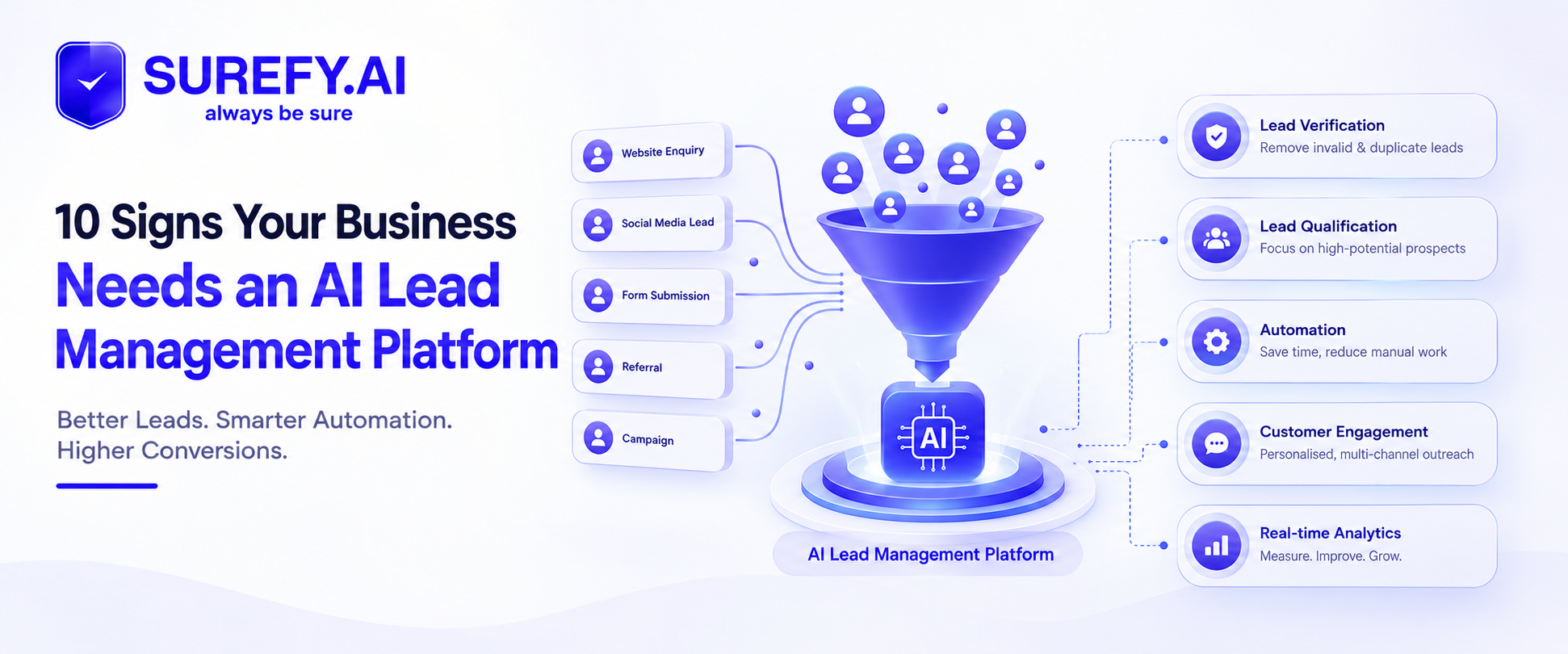
An AI Lead Management Platform helps businesses streamline lead capture, verification, qualification, prioritisation, follow-ups, and customer engagement. By combining automation with data-driven insights, it can help sales and marketing teams work more efficiently and make better decisions.
But how do you know when your existing process is no longer enough?
Here are 10 signs your business may be ready to adopt AI-powered lead management and improve the way it turns prospects into customers.
What is an AI Lead Management Platform?
An AI Lead Management Platform is a software solution that helps businesses capture, organise, verify, qualify, track, and nurture leads using automation, artificial intelligence, and data-driven workflows.
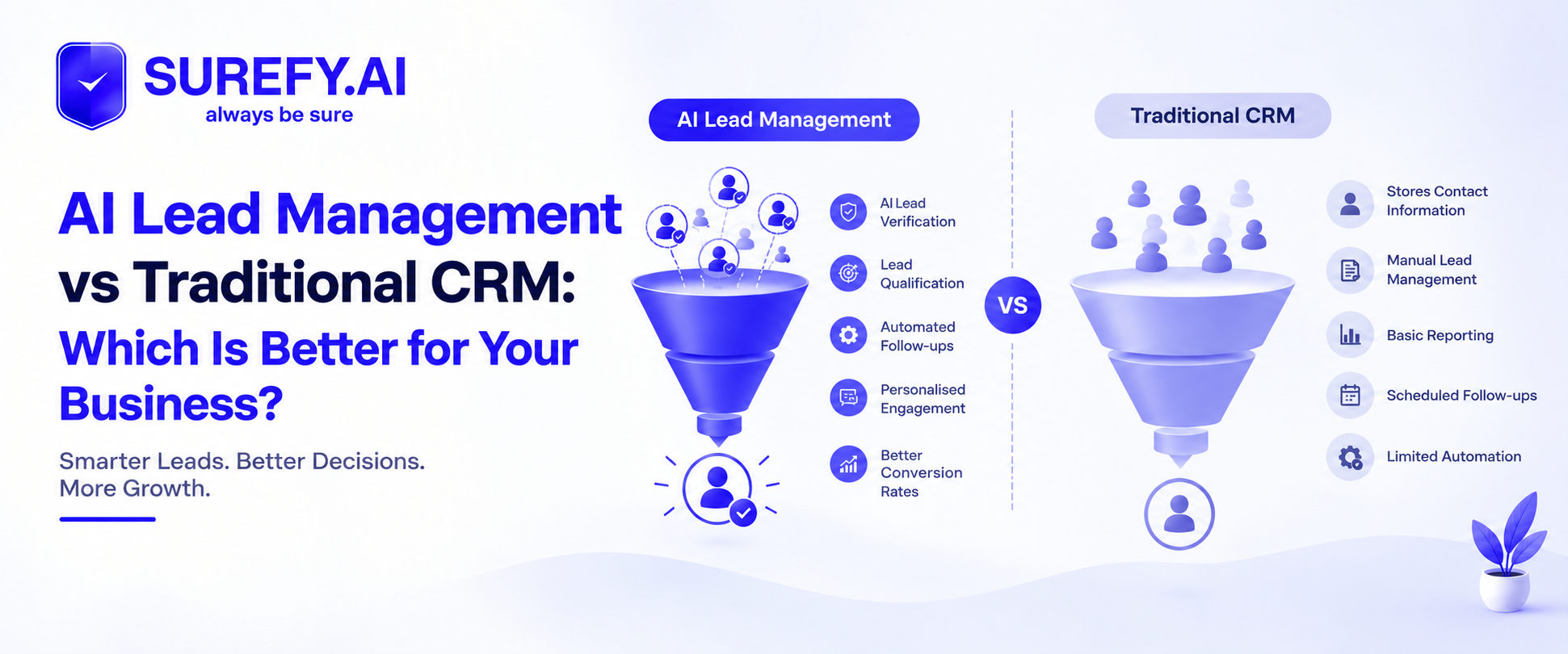
Unlike a basic spreadsheet or a traditional lead tracking system, an AI-powered platform can help identify patterns in customer behaviour, prioritise promising prospects, automate routine tasks, and support timely communication.
Depending on its features and integrations, a platform may bring together lead capture from multiple marketing channels, AI-powered verification, lead qualification, automated follow-ups, campaign management, and analytics.
The goal is not simply to collect more leads. It is to help businesses manage their leads more effectively, improve sales productivity, and create a smoother customer journey.
10 Signs Your Business Needs an AI Lead Management Platform
1. Your Business Generates Leads, but Conversions Remain Low
Receiving hundreds of enquiries does not automatically translate into higher sales. If your business generates a large number of leads but struggles to convert them into paying customers, the problem may lie in how those leads are managed.
Some prospects may have a genuine need for your product, while others may be researching options or may not fit your ideal customer profile. Without a structured process to distinguish between them, sales teams can spend too much time on low-potential enquiries.
An AI Lead Management Software solution can help analyse available lead information, identify relevant patterns, and prioritise prospects based on defined criteria. This allows sales representatives to focus on opportunities that are more likely to progress.
A well-designed approach to Verified Lead Generation also helps businesses look beyond lead volume and pay closer attention to lead quality.
What to look for: A system that supports lead scoring, qualification rules, data validation, and performance tracking.
2. Your Sales Team Spends Too Much Time on Manual Tasks
Are your sales representatives manually entering customer details, updating spreadsheets, assigning leads, and sending repetitive follow-up messages?
These activities may seem manageable when lead volumes are low. However, as the business grows, manual processes can consume time that would otherwise be spent understanding customer needs and closing deals.
An AI Lead Management Platform can help automate repetitive tasks such as lead assignment, status updates, workflow triggers, and follow-up reminders, depending on the available features.
This is where AI Sales Automation becomes valuable. By reducing routine administrative work, automation helps sales teams maintain a more consistent process and concentrate on meaningful conversations.
For example, when a prospect submits an enquiry through a website form, an automated workflow can capture the information, assign the lead to the appropriate representative, and trigger a timely response.
What to look for: Workflow automation, automatic lead distribution, task reminders, and integrations with existing business tools.
3. Your Team Frequently Misses Follow-Ups
A prospect enquires about your product, but nobody responds until the next day. Another prospect receives an initial call but never gets a second follow-up. Meanwhile, your competitors continue engaging with potential customers.
Missed follow-ups can weaken the customer experience and reduce the chances of converting interested prospects.
An AI Lead Management Platform can help establish structured follow-up workflows based on lead status, customer preferences, and predefined business rules. Teams can schedule reminders, trigger communication sequences, and track whether the next action has been completed.
When integrated with a Customer Engagement Platform, these workflows can support communication through channels such as email, SMS, voice, or WhatsApp, where available and permitted.
The objective is not to overwhelm prospects with messages. It is to ensure that relevant communication happens at an appropriate time.
What to look for: Automated reminders, follow-up scheduling, communication history, and configurable customer engagement workflows.
4. Your Business Receives Invalid, Duplicate, or Incomplete Leads
Not every enquiry contains accurate or usable information. Businesses may receive duplicate submissions, incorrect phone numbers, incomplete forms, or contact details that make follow-up difficult.
When sales teams repeatedly attempt to contact invalid leads, valuable time and resources are wasted.
AI Lead Verification and Customer Data Validation can help identify potential data quality issues before they affect the sales process. Depending on the system and verification methods available, businesses may be able to flag duplicates, check field completeness, validate supported contact information, and route questionable records for further review.
A dedicated Lead Verification Software solution can also support consistent checks across different lead sources.
For businesses that require more extensive checks, a Customer Verification Platform or Customer Data Verification Platform may provide additional verification workflows. These capabilities should be selected according to the business’s requirements, applicable regulations, and the data sources available.
Businesses can also explore Digital Customer Verification to support suitable digital verification workflows.
It is important to remember that a verification result does not automatically establish that a person is genuinely interested in purchasing.
What to look for: Duplicate detection, configurable validation rules, supported verification integrations, and clear records of verification outcomes.
5. Your Sales Team Cannot Identify the Most Promising Prospects
When every lead appears equally important, sales representatives may struggle to decide whom to contact first.
A person requesting a product demonstration may be at a different stage of the buying journey than someone who has only downloaded a general information guide. Treating both prospects identically can lead to inefficient use of sales resources.
Lead Qualification Software helps businesses evaluate prospects using factors such as customer requirements, company profile, engagement history, budget information, and other relevant criteria.
An AI-powered system may use available data to recommend priorities or identify patterns associated with previous conversions. However, the quality of these recommendations depends on data availability, model design, and the suitability of the scoring criteria.
With an AI Lead Verification Platform and lead qualification workflow working together, businesses can assess data quality separately from sales readiness.
This distinction matters: a lead can have valid contact information but still have little interest in purchasing.
What to look for: Custom lead scoring, qualification criteria, priority-based routing, and transparent explanations of why leads receive particular scores.
6. Your Customer Data is Scattered Across Multiple Tools
Your marketing team tracks enquiries in one spreadsheet, sales representatives maintain separate contact lists, and customer communication records sit in different applications.
When information is spread across disconnected systems, employees may struggle to access a complete view of each prospect. The result can be duplicated effort, inconsistent communication, and difficulty understanding the customer’s journey.
A well-integrated AI Lead Management Platform can centralise lead records or synchronise information across supported tools. Integrations with a CRM, marketing system, communication platform, or analytics solution can help teams work with more consistent information.
A Business Verification API may also support specific business verification checks when the provider offers the required data and integration.
Before selecting a platform, businesses should evaluate its compatibility with their existing systems rather than assuming every tool supports every integration.
What to look for: API access, integration capabilities, centralised lead records, access controls, and reliable data synchronisation.
7. Your Marketing Campaigns Generate Activity but Little Business Insight
Your team runs paid advertising campaigns, email promotions, and social media activities. Website visits and enquiries increase, but it remains difficult to determine which channels produce qualified leads and actual sales.
Without reliable tracking, marketing decisions may depend more on assumptions than on measurable business outcomes.
Campaign Management Software and a Marketing Automation Platform can help businesses organise campaigns, manage customer segments, schedule communications, and track campaign interactions.
When these capabilities are connected with lead management and sales reporting, businesses can evaluate performance across more of the customer journey.
For instance, a marketing team may discover that one campaign produces many enquiries while another generates fewer leads but a higher proportion of qualified opportunities. That insight can help inform future campaign decisions.
An AI Marketing Platform may offer additional analytics, segmentation, or predictive capabilities, depending on the solution.
What to look for: Campaign attribution, lead-source tracking, conversion reporting, segmentation, and dashboards that connect marketing activity with sales outcomes.
8. Your Business Struggles to Scale Lead Generation
As your business expands, you may begin receiving enquiries from additional advertising channels, regions, customer segments, or product categories.
Processes that worked for a small sales team may become difficult to manage at a larger scale. Manual assignment, inconsistent qualification, and delayed responses can create operational bottlenecks.
An AI Lead Management Platform can help standardise workflows so that growing lead volumes do not automatically require a proportional increase in manual administration.
When paired with AI Lead Generation Software, businesses may also be able to connect lead acquisition activities with qualification, verification, and follow-up workflows.
However, lead generation and lead management serve different purposes. Lead generation attracts potential customers, while lead management helps organise and progress those prospects towards a business outcome.
A Verified Lead Generation Platform should therefore be evaluated not only by how many records it supplies, but also by its verification methods, data quality, consent practices, and relevance to the target audience.
What to look for: Scalable workflows, flexible integrations, multi-source lead capture, and reporting that remains useful as volumes increase.
9. Your Customer Communication Feels Generic and Inconsistent
Modern customers expect businesses to understand their needs and communicate with relevance. Sending the same message to every prospect, regardless of their interests or stage in the buying journey, can make communication feel impersonal.
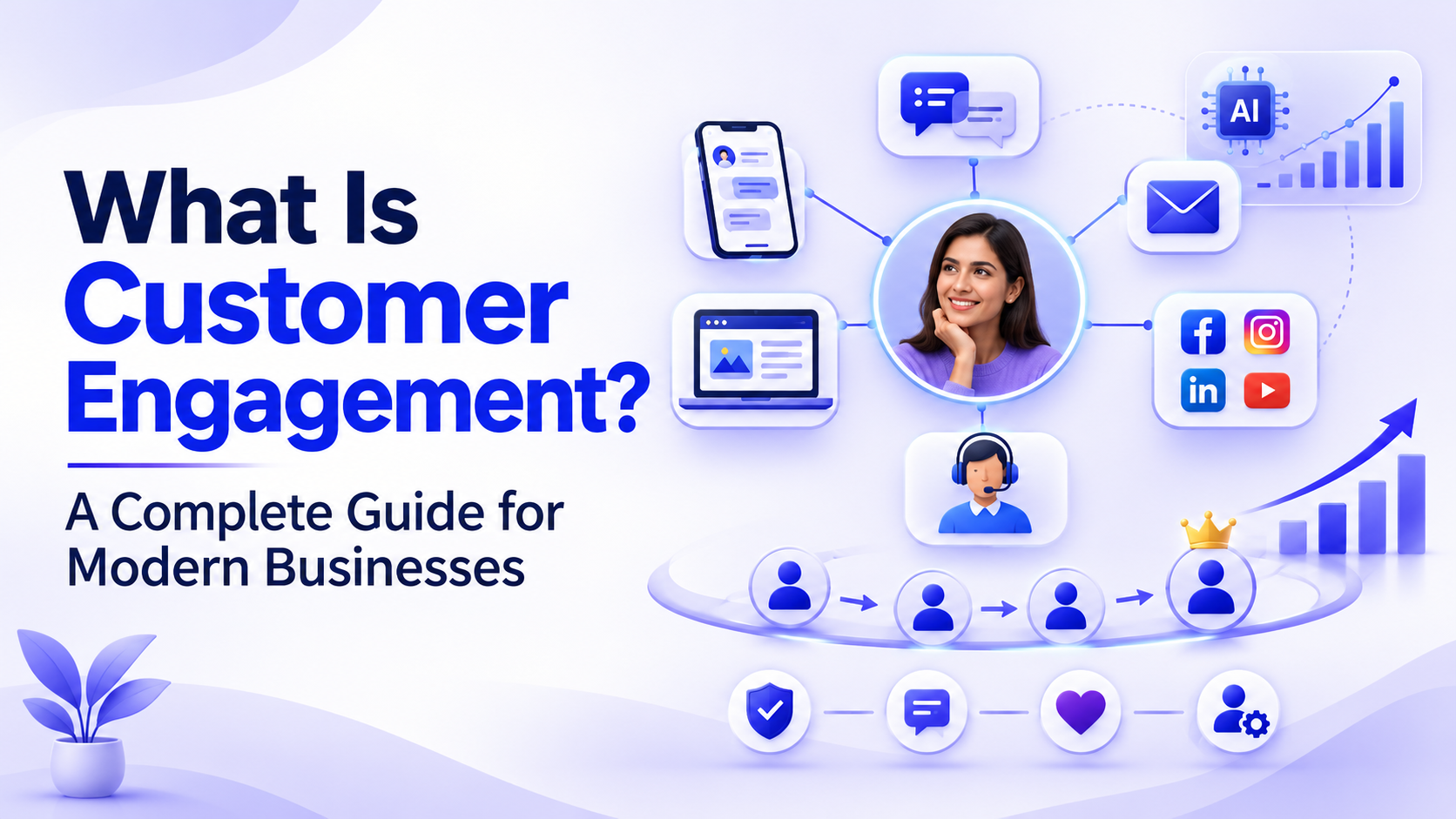
A Customer Engagement Platform can help businesses organise interactions across supported channels and create more relevant communication journeys.
For example, someone who has requested a product demonstration may need a different follow-up from someone who is still comparing solutions. Segmentation and workflow automation can help businesses deliver appropriate messages to each group.
An AI-powered system may also help teams identify engagement patterns and recommend next steps. These recommendations should be reviewed against customer preferences, communication permissions, and the context of the interaction.
The goal is to build stronger customer relationships through useful, timely communication rather than simply increasing the number of messages sent.
What to look for: Audience segmentation, communication history, personalised workflows, channel integration, and consent management.
10. Your Business Cannot Measure the True Performance of Its Lead Process
If management cannot confidently answer questions such as how quickly leads receive their first response, how many become qualified opportunities, or which stages lose the most prospects, improving sales performance becomes difficult.
A structured AI Lead Management Platform can help establish visibility across the entire lead lifecycle.
With suitable analytics, businesses can monitor lead sources, response times, qualification rates, follow-up completion, conversion rates, and campaign performance. AI-assisted insights may help identify patterns that deserve further investigation.
For example, a business may find that many qualified prospects stop responding after the first interaction. That observation could prompt a review of follow-up timing, messaging, sales processes, or product positioning.
The value of analytics comes from using the findings to improve decisions, not simply collecting more reports.
What to look for: Custom dashboards, funnel reporting, conversion tracking, performance comparisons, and actionable insights that sales and marketing teams can understand.
How to Choose the Right AI Lead Management Platform
Recognising these signs is the first step. The next is selecting a solution that addresses your actual business challenges.
Before making a decision, evaluate the following factors:
1. Lead capture and management: Can the platform collect and organise leads from the channels your business uses?
2. Verification and data quality: Does it support the contact validation, duplicate detection, or business verification checks you require?
3. Lead qualification: Can you define qualification rules that reflect your ideal customer profile and sales process?
4. Automation capabilities: Can the platform automate repetitive tasks, lead assignment, reminders, and relevant communication workflows?
5. Customer engagement: Does it integrate with the communication channels your customers prefer?
6. Reporting and analytics: Can your team track lead quality, sales progress, campaign performance, and conversion outcomes?
7. Integration and scalability: Will it work with your existing CRM and business systems, and can it support your expected growth?
8. Privacy and compliance: Does the solution provide appropriate access controls, data handling safeguards, and support for applicable privacy and communication requirements?
The best platform is not necessarily the one with the largest number of AI features. It is the one that solves your most important problems, fits your existing workflows, and provides measurable business value.
How Surefy.ai Can Support Smarter Lead Management
Businesses looking to improve lead quality and customer engagement can explore solutions that bring lead management, verification, automation, and communication workflows closer together.
Surefy.ai focuses on areas including AI Lead Management, Customer Engagement, Lead Verification, KYC APIs, WhatsApp Business API, Voice and SMS Campaigns, Analytics, and AI Automation.
Depending on the selected solution and available integrations, these capabilities can help businesses organise lead-related activities, support customer verification processes, manage communication workflows, and gain better visibility into engagement.
For organisations experiencing missed follow-ups, inconsistent lead data, or disconnected marketing and sales processes, an integrated approach can be a useful step towards more efficient lead management.
Explore Surefy.ai to learn more about its offerings and identify the capabilities that align with your business needs.
Conclusion
An increase in lead volume does not always result in an increase in sales. Businesses also need reliable data, effective qualification, timely follow-ups, relevant communication, and clear performance tracking.
If your sales team is spending too much time on manual tasks, struggling with poor-quality leads, missing follow-ups, or finding it difficult to measure conversions, it may be time to consider an AI Lead Management Platform.
By bringing lead management, verification, automation, and customer engagement into a more coordinated process, businesses can make better use of their sales and marketing resources.
The key is to start with your most pressing challenges, choose technology that addresses them, and measure the results over time.
A smarter lead management process is not about chasing more leads. It is about helping your business identify, engage, and convert the right opportunities more effectively.
Frequently Asked Questions (FAQs)
1. What is an AI Lead Management Platform?
An AI Lead Management Platform is software that helps businesses capture, organise, qualify, prioritise, and nurture leads using automation, artificial intelligence, and data-driven workflows. Depending on its capabilities, it can reduce manual work and help sales teams focus on promising opportunities.
2. What are the signs that a business needs AI lead management software?
Common signs include low conversion rates despite high lead volumes, missed follow-ups, excessive manual work, invalid or duplicate leads, disconnected customer data, inconsistent communication, and limited visibility into sales performance.
3. How does AI improve lead management?
AI can analyse available lead data, support lead scoring, identify patterns, recommend priorities, and assist with workflow automation. Results depend on the quality of the data, the system’s capabilities, and how the business configures and uses it.
4. What is the difference between AI lead generation and AI lead management?
AI lead generation focuses on attracting or identifying potential customers. AI lead management focuses on organising, verifying, qualifying, tracking, and nurturing those prospects after they enter the sales process. The two can work together as part of a broader sales and marketing workflow.
5. How does AI Lead Verification help businesses?
AI Lead Verification can help identify potential issues in lead records, such as duplicates, incomplete information, or contact details that require validation. The checks available depend on the technology and data sources used. Verification alone does not guarantee that a prospect is genuine or ready to buy.
6. Can an AI Lead Management Platform improve sales conversion rates?
It can support conversion improvement by helping teams prioritise leads, respond more consistently, reduce administrative delays, and identify weaknesses in the sales funnel. Actual results depend on the quality of implementation, sales practices, product-market fit, and lead sources.
7. What is the role of a Customer Engagement Platform in lead management?
A Customer Engagement Platform helps businesses manage interactions with prospects and customers across supported communication channels. When integrated with lead management, it can support timely follow-ups, audience segmentation, communication tracking, and more relevant customer journeys.
8. What is a Business Verification API?
A Business Verification API enables an application to request business-related verification checks from a supported service. Depending on the provider, these checks may cover business identity or registration information. Businesses should confirm the available data, geographic coverage, and applicable compliance requirements before integration.
9. Is AI Lead Management Software suitable for small businesses?
Yes. Small businesses can benefit when lead volumes, manual administration, or missed follow-ups begin affecting sales productivity. The right solution should match the business’s budget, workflow complexity, integration needs, and growth plans.
10. How should a business measure the success of an AI Lead Management Platform?
Useful metrics include lead response time, data completeness, qualification rate, follow-up completion, lead-to-opportunity conversion, customer acquisition cost, and sales conversion rate. Compare results against a reliable baseline and evaluate performance over an appropriate period.
11. What is the difference between lead verification and lead qualification?
Lead verification checks whether available lead information meets specified validity or verification criteria. Lead qualification assesses whether a prospect is a suitable potential customer based on factors such as needs, budget, authority, timing, and fit. A lead can pass verification without being qualified.
12. What should businesses consider before adopting a Verified Lead Generation Platform?
Businesses should assess lead relevance, data accuracy, verification methods, consent and privacy practices, source transparency, integration options, and reporting. Lead quality should be evaluated against actual business outcomes rather than lead volume alone.