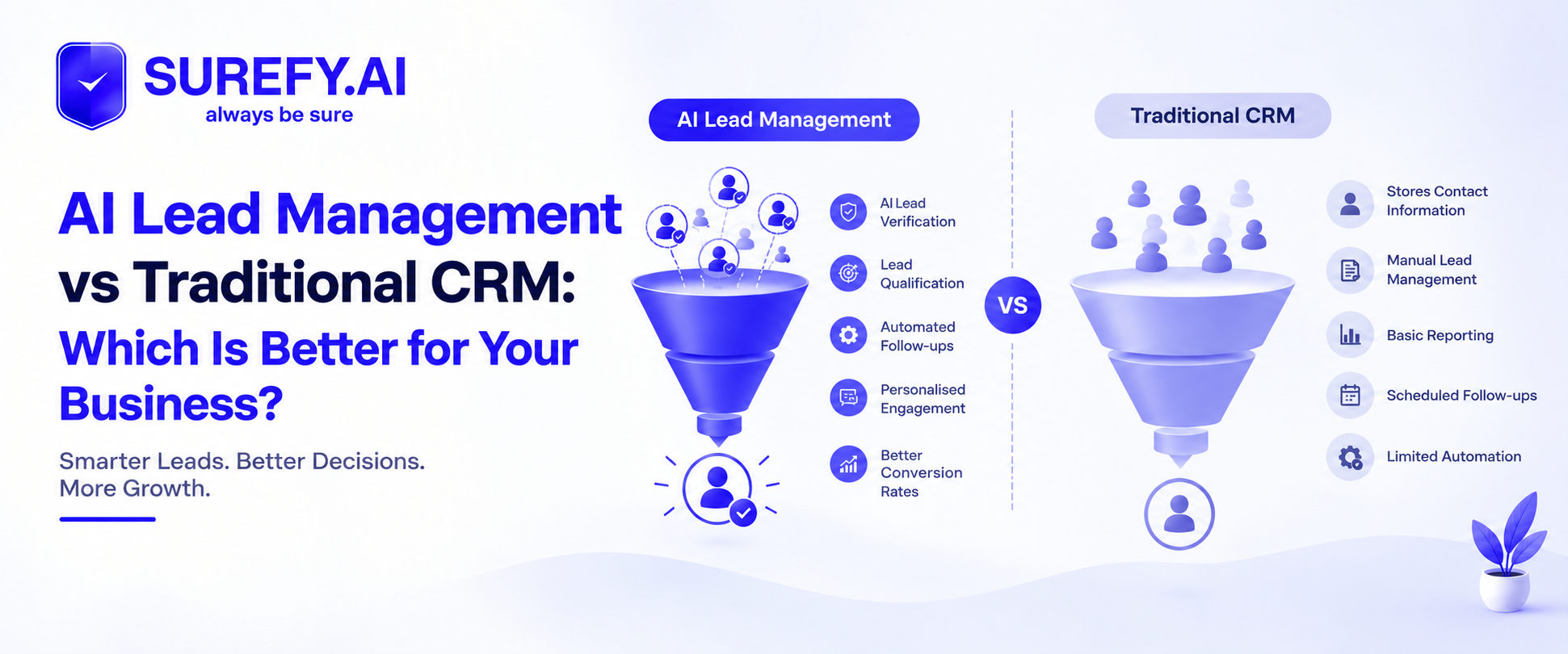


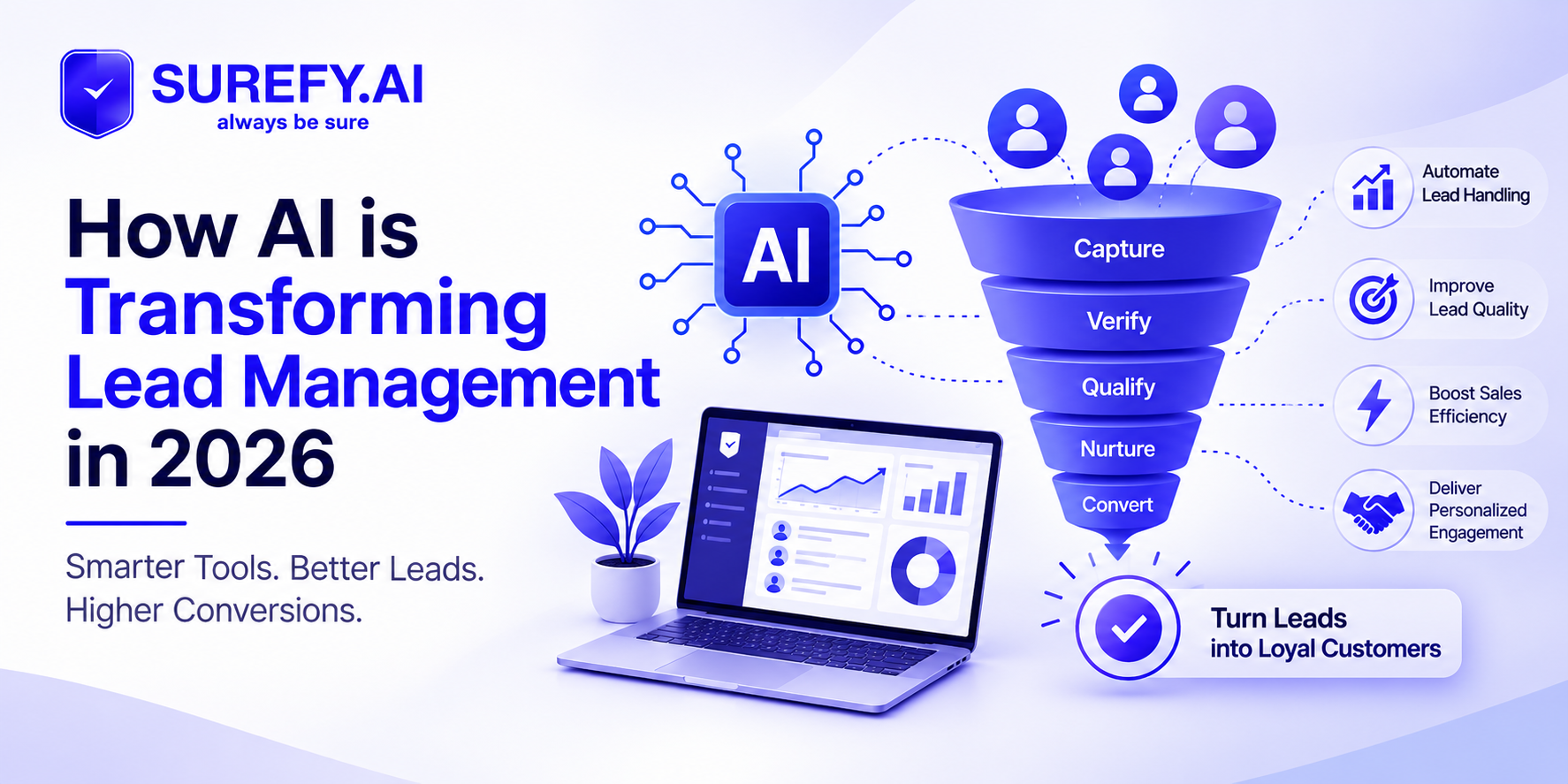
Using machine learning, automation, and real-time data checking, AI lead management is capturing, verifying, scoring, nurturing, and routing leads with very little manual effort. Lead management with automation powered by an AI marketing platform has a few big advantages over manual lead management. It results in cleaner data, faster lead follow-up, more sales at lower costs, and, overall, higher efficiency.
We all know the pain of fake data, fake numbers, and fake email addresses in response to marketing. Your campaign draws interest and results in a few hundred enquiries, and yet, they are almost all fake and don’t convert to sales.
In 2026, sales and marketing teams of smaller companies and even solo entrepreneurs will learn to value the use of AI in lead management and AI lead generation software. In the next few years, the big tech companies will adopt the same technology as AI becomes more ubiquitous, even for the smallest companies and solo entrepreneurs.
In this guide, we cover the latest advancements in lead management and the AI trend that will reshape the way sales and marketing teams function. We’ll explore practical examples that you can start using today. We also discuss starting AI lead management with little or no money.
What is AI Lead Management?
Using artificial intelligence to perform all parts of the lead cycle – capturing, qualifying, verifying, scoring, nurturing, routing, and reporting – lead management is one of the more exciting applications of AI.
Conventional lead management has the human touch to enter and qualify the leads and score them. Unlike human managers, AI performs lead management continuously at a massive scale and learns through every transaction.
A typical modern AI lead management software does five main things:
- Captures leads from websites, ads, WhatsApp, forms, and offline events.
- Ensures the details and the identity of the lead are correct through a customer verification platform.
- Classifies and ranks leads based on their behaviour and match with your offer.
- Sends the lead a relevant offer at the right time through the appropriate channel using a customer engagement platform.
- Provides lead analysis and reports what works.
Why Traditional Lead Management is Breaking Down
Technology has outpaced traditional manual lead management processes.
The budget is wasted by poor data.
It is better to have no leads than fake leads. You spend money on advertising, your sales staff spends time on fake leads, and messaging credits are wasted. The lead generation game becomes a numbers game with fake lead information, especially without lead verification software in place.
Slow lead response = low conversion rates.
With the ability to compare all available options at the touch of a button, it takes only one slow response to lose a sale to the competition. The current lead routing and lead response processes become obsolete in this new competitive landscape, unless they are backed by a marketing automation platform.
The gap between sales and marketing teams becomes larger.
Marketing teams will claim that they are generating many leads, while sales teams complain about lead quality. With no unified lead information and a lead quality assessment system, marketing and sales will continue to work based on completely different sets of assumptions.
Compliance and trust are tightening.
Responsible handling of customer data is the current norm, and customers expect businesses to do this as well. Privacy and data protection regulations demand that companies manage their data, including through digital customer verification and proper consent records. In addition, the scattergun approach to lead generation has outlived its usefulness.
Predictions on the AI Lead Management Landscape in 2026
The adoption of AI lead management tools will follow the trend of the industry. The lead management software solutions will have a greater focus on AI lead verification platform capabilities in the upcoming year.
1. The Paradigm Shift: Verification Before Lead Generation
In this digital age, businesses will place greater emphasis on lead generation quality over lead generation quantity. Rather than capturing leads and later refining them, businesses will be verifying leads during lead capture.
AI Lead Verification helps to detect whether or not an email has the possibility of being delivered, whether a submission is likely human, and whether the lead has provided an active phone number. All of these features are the building blocks of verified lead generation, which a verified lead generation platform delivers. All of these features are the building blocks of verified lead generation and provide the rationale for a lead verification system to be fully integrated with a CRM.
2. AI Lead Qualification
Lead qualification systems will continue to replace lead scoring systems with the use of machine learning. Lead qualification software will predict lead buying intent and likelihood through analysing lead behaviours, including but not limited to the number of pages a lead has visited, response times, lead source, geographic location, and historical lead conversions.
Your team stops guessing and starts calling the right people first.
3. AI-powered sales automation and workflows
The ability of AI sales automation in 2026 is beyond the automated sending of simple drip emails. In many scenarios, it’s capable of making a smart next step by choosing between the options of sending a WhatsApp reminder, reassigning the prospect to a senior salesperson, scheduling a call, or even temporarily pausing all sales automation for a prospect when they show low buying intent.
AI does all the coordination, and salespeople focus on the client and the sales closing process.
4. Conversational and omnichannel engagement
Consumers expect real-time answers in the way that best fits them, including on SMS, WhatsApp, voice, or email. The software that powers this is a customer engagement platform, which should connect all interactions and threads for customers so that prospective leads don’t repeat information.
5. Connected sales and marketing systems
Tools for sales and marketing are increasingly converging to avoid customers managing 5 different, disjointed tools. Sales and marketing teams want integrated systems for prospect and lead management, along with campaign management software and sales and marketing automation on one marketing automation platform that also includes reporting in one system.
6. Privacy and data ethics with consent management
Customer data is the foundation of trust. Businesses now focus on customer data privacy, customer data validation, and consent management to build trust with their customers as an integral part of their processes.
- The Building Blocks of AI Lead Management
- Confidence comes from knowing the technology that goes into your stack.
- Scoring and Prediction via Machine Learning
- By training your own custom ML model, you’ll be able to tell what matters for your business.
Natural Language Processing (NLP)
NLP lets a system ‘read’ and understand customer input and reply with the correct classification, intent, and/or answer to common questions. It’s also capable of detecting urgency and can flag customer issues.
Real-time Verification APIs
A Business Verification API provides the ability to integrate verification processes directly into forms and onboarding workflows. It also powers verification services on digital platforms to verify individuals and businesses, supporting digital customer verification at scale.
Benefits of Using AI for Lead Management
Understanding the technology behind a tool allows you to accurately assess a system.
Machine Learning Scoring and Prediction
This technology learns from a user’s previous successes and losses. As a result, it can determine which factors and variables matter most to your business.
Natural Language Processing
Natural Language Processing (NLP) provides a system with the ability to read and understand a customer’s message. With this ability, it can classify customer messages, provide answers to customers’ frequently asked questions, and flag urgent messages for a customer.
Real-time Verification APIs
Businesses can integrate real-time verification APIs directly into forms, applications, and their digital onboarding processes. An API helps to verify and validate data before businesses waste their time and efforts on customers that are not legitimate, a core function of any customer data verification platform.
Workflow Automation Engines
Workflow automation engines perform automated tasks, such as assigning a customer record to a specific team member and following up on records.
AI-Driven Attribution
AI connects spend to actual paying customers and revenue, rather than simply analysing clicks. It helps businesses to understand which messages, channels, and campaigns bring in real customers.
AI-Based Lead Management Solutions Deliver Measurable Improvements in Several Business Areas:
- Increased Quality of Lead Contacts: The technology improves the validity of lead contacts and eliminates the cost associated with contacting the wrong customer.
- Speed of Customer Contact: Lead Management AI technology drastically improves customer contact response times.
- Customer Lead Conversion: Automation enables sales teams to focus on the customer contact that most drives lead conversion and reduces the effort involved in following up on leads.
- Customer Lead Acquisition: Eliminating fake leads through contact validation reduces advertising costs.
- Lead Management Systems Ensure Unity Across the Business: Sales and marketing teams can share the same lead database.
- Customer Lead Scaling: The system increases lead volume without the necessity of additional employees.
Measurable Return on Investment: Clearly displays the source of revenue. It is possible to see measurable gains by comparing data points over the initial three months to understand what works for your business.
Practical Applications: How Different Businesses Use AI Lead Management
For MSMEs and smaller businesses
One example would be a coaching institute that advertises using both Facebook and Google Ads. A member of staff previously had to call each enquiry made on their form, many of which had been made using incorrect details. With the new system, customer details are verified by a customer verification platform. Each customer enquiry is answered instantly via a WhatsApp message, allowing the coaching staff to concentrate on prospective clients and parents.
As every minute spent by an MSME is precious, wasting hours chasing up non-existent customers can be costly.
For digital marketers and agencies
An agency that manages a variety of clients uses a campaign management system that incorporates verification for both lead counts and, for the first time, qualified leads. Using this system for reporting results builds greater trust, in turn encouraging more clients to renew their service.
Greater lead quality as well as lead quantity builds trust in agencies by clients.
For sales teams
Leads are directed to real estate teams by a combination of referrals, advertisements, and sources of lead generation on the Internet. Thanks to lead scoring and generation software using AI, teams of salespeople can now direct their attention towards prospects who show interest in pricing, whereas leads with lower intent to purchase are automatically added to nurture streams.
Using lead software means salespeople can focus on what they are best at—selling—rather than spending time sorting.
For the fintech, insurance, and financial industries
These areas of the industry have to perform some form of customer identity verification before engaging in business. With a system that verifies customers’ identity digitally along with a workflow that verifies customer data, these sectors can drastically reduce their risk of fraud while speeding up the customer onboarding process and maintaining an audit log.
Using identity verification software and processes in a company has benefits for risk management that go beyond marketing.
For e-commerce and D2C brands
Fake cash-on-delivery orders cause significant returns. Verifying addresses and phone numbers before shipping significantly reduces costs, and automated engagements recover abandoned orders.
How Surefy AI Supports Smarter Lead Management
Verified lead generation: build your pipeline by using verified data from the get-go.
- AI lead verification and data validation: eliminate duplicate, fake, and invalid leads in your database.
- Business verification API: integrate Surefy’s verification checks directly into your own forms, apps, and workflows.
- Lead qualification and scoring: know who you should reach out to and when.
- AI sales automation: save your team time by automating follow-up and lead routing
- Customer engagement and campaign management: design and launch multichannel campaigns from a single dashboard
Getting Started With AI Lead Management
You do not need to do a full process overhaul to start leveraging AI for your sales lead management. Start by using the steps below.
- Perform an audit of your leads to understand the pain points. Consider what percentage of your leads have invalid data, duplicate entries, and lack any type of sales interaction.
- Clearly define what constitutes a lead and gain alignment from sales and marketing on what these definitions are.
- Install lead validation on your data collection sources. Validate email addresses and phone numbers during the data collection phase.
- Get your automation in place. Send out instant messages, which is the bare minimum that will get your leads more engaged.
- Introduce lead scoring and lead routing. Use this process to prioritise the leads you think are most ready to engage with sales.
- Focus on your continuous improvement efforts. Track and optimise for key metrics such as your cost per verified lead, your lead response times, and your conversion rate.
Common Mistakes to Avoid
- Automating a broken process. Fix your qualification criteria before scaling them.
- Ignoring data hygiene. AI is only as good as the data it learns from.
- Removing the human touch. Use AI to support relationships, not replace them.
- Choosing tools by features alone. Look at integration, support, security, and ease of use.
- Skipping consent and compliance. Responsible data handling protects your brand.
Conclusion
The Future of Lead Management is Verified, Intelligent, and Automated. By 2026, the companies capturing the most customers won’t necessarily be the companies that are capturing the most leads. In 2026, businesses that are winning will be the businesses that have verified leads and quickly qualify and engage them.
Artificial intelligence has transformed the process of converting incoming customer queries into an effective engine for company growth, and even small businesses and micro-enterprises can now take advantage of the benefits. For those who want to reduce the waste associated with unnecessary spending, quickly answer enquiries, and allow their staff to focus their time on serious prospects, Surefy AI has developed the solution.
Surefy AI will help you to begin building an intelligent customer acquisition engine, and for this, please reach out and schedule a demo.
Frequently Asked Questions (FAQs)
1. What is AI Lead Management?
AI lead management allows you to automatically manage incoming enquiries, reduce your workload, and let your staff focus on the people who are ready to purchase your goods and services.
2. How can AI help with lead generation?
With AI, you can capture high-value customer leads and know who the most promising leads are, with customer lead profiles that you can tailor to your needs. With AI, you also know what kind of lead capture method, communication style, and customer outreach methods are most successful.
3. What is AI Lead Verification?
AI Lead Verification verifies your customers and removes any entries that you know are fake. AI Lead Verification allows you to remove duplicate leads, leads generated by automated bots, fake leads, and invalid leads from your database, and your lead list remains clean.
4. How do you define ‘lead verification’ and ‘lead qualification’?
Lead verification simply validates the information for the prospect. Lead qualification validates whether a prospect is a real lead that you will actually want to do business with. Both are crucial to having an effective sales process.
5. What does a business verification API do?
A Business Verification API provides the ability to integrate verification and validation into your own software, system, or website. It lets you capture data in real time, validating customer data in real time as well, ensuring incomplete data never even reaches your sales funnel.
6. Is AI lead management good for smaller organisations?
Yes. Many AI-based lead management solutions come with a very reasonable price tag and require no dedicated staff. Smaller organisations are the ones who benefit the most, saving money on a marketing budget and time from employees.
7. How does a CRM differ from AI lead management software?
While CRM stores customer information, AI lead management software verifies, scores, automates, and predicts information and enables users to decide who to reach out to, when, and by what means. Often CRM is used in conjunction with lead management software, which helps the CRM software to ingest validated data.
8. What does AI sales automation actually do?
The goal of AI sales automation is to simplify and manage the process of interacting with potential leads. It uses machine learning to decide which messages, actions, or tasks (such as meetings, reminders, or assigning leads) need to be completed, at what time, and for which lead, based on the behaviour and the lead score. Most marketing automation software integrates this into its system and allows all actions to be managed from a central interface.
9. Is it possible for artificial intelligence (AI) to replace salespeople?
It’s not; AI still does tasks like data entry, sorting, and quick replies. Building relationships and really understanding a potential client and closing the sale are still best done by a person. Software for lead verification actually supports this by assisting users to spend their valuable time with only qualified prospective clients.
10. What’s the best approach for choosing AI lead management?
Try to find software with built-in verification, the ability to connect to other applications easily, and the ability to easily engage across various platforms, while having robust reports and data security.