


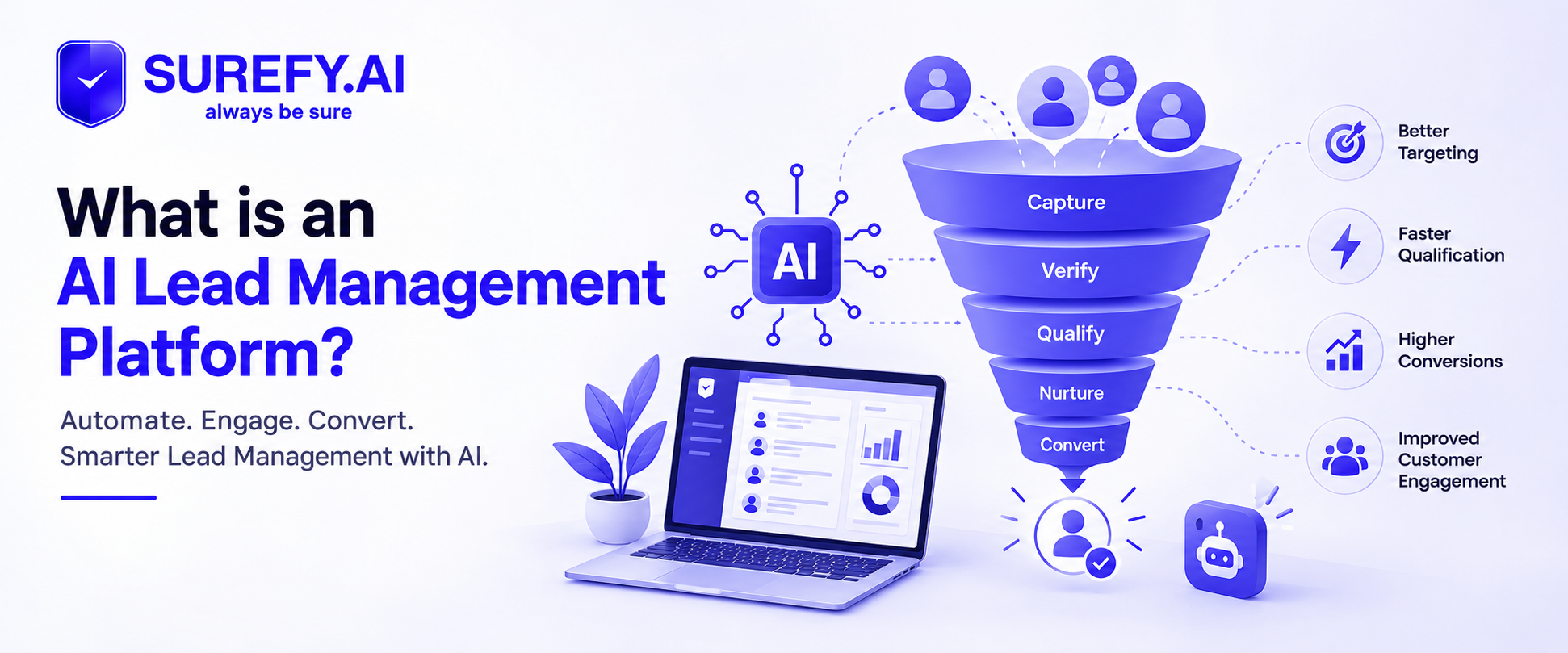
What is an AI Lead Management Platform?
Managing leads effectively has become increasingly important for businesses that generate prospects through multiple channels such as websites, advertising campaigns, social media, WhatsApp, forms, landing pages, calls, and other digital channels.
An AI Lead Management Platform brings these lead-related activities into one system and uses artificial intelligence to make the process more automated and data-driven.
Instead of simply storing contact information, an AI-powered platform can help businesses determine:
- Where a lead came from
- Whether the lead information is valid
- Whether the prospect matches the business’s target customer profile
- How valuable the lead may be
- Which sales representative should handle the lead
- When the prospect should be contacted
- What type of follow-up may be appropriate
- Whether the lead is ready for sales engagement
In simple terms, an AI Lead Management Platform helps businesses move from “collecting more leads” to “managing and understanding leads more intelligently.”
An AI Lead Management Platform is a software solution that uses artificial intelligence to capture, verify, qualify, prioritize, distribute, and manage leads throughout the sales lifecycle. Unlike traditional lead management systems that rely heavily on manual processes, an AI-powered platform can analyze lead data, identify high-potential prospects, automate follow-ups, validate customer information, and help sales teams focus on leads that are more likely to convert.
How Does an AI Lead Management Platform Work?
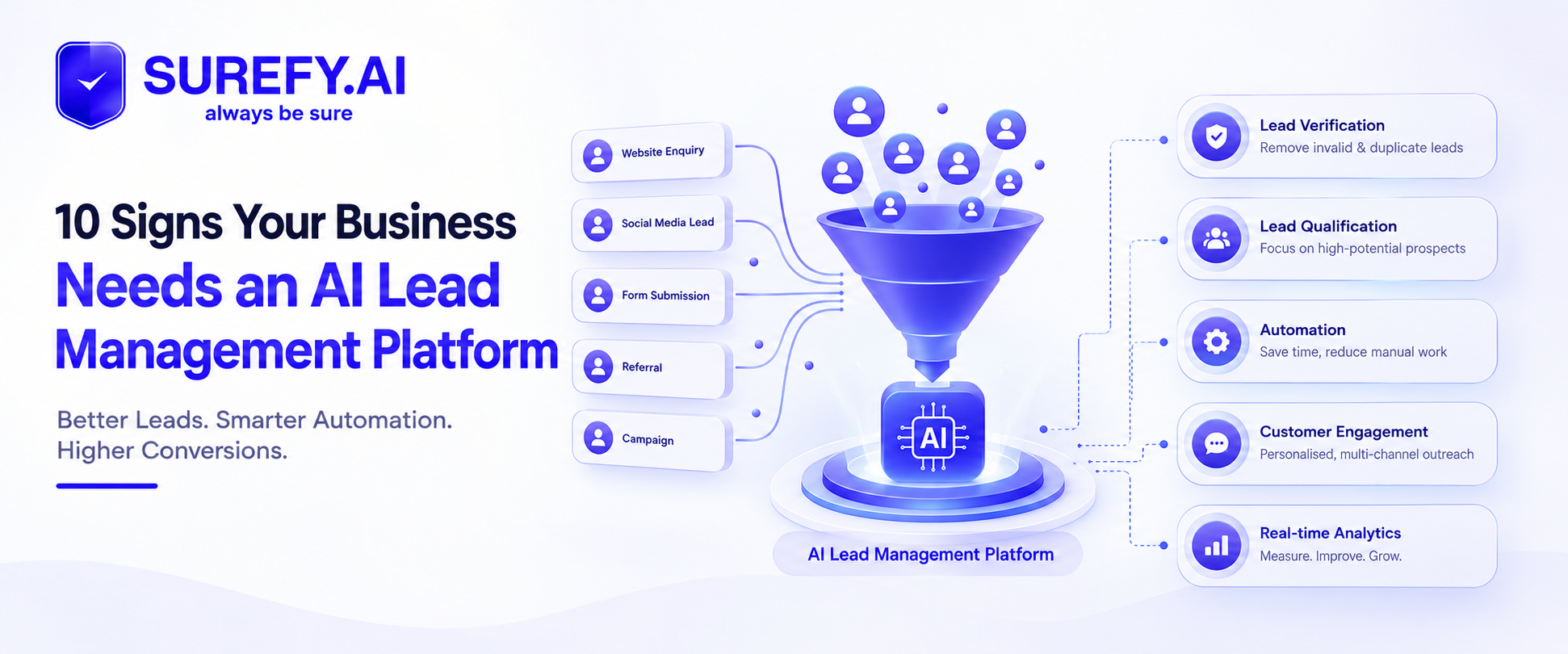
An AI Lead Management Platform typically connects several stages of the lead lifecycle into one workflow.
1. Lead Generation
Leads can enter the system through multiple sources, including:
- Website forms
- Landing pages
- Google Ads
- Social media campaigns
- WhatsApp campaigns
- Email marketing
- Voice campaigns
- SMS campaigns
- Referral programs
- Partner channels
- APIs and third-party applications
An AI Lead Generation Software solution can help businesses organize leads generated from different sources and bring them into a centralized system.
2. Lead Capture
Once a prospect submits information, the platform captures relevant data such as:
- Name
- Phone number
- Email address
- Company
- Location
- Product interest
- Campaign source
- Interaction history
Centralized data makes it easier for marketing and sales teams to track prospects throughout the buying journey.
3. AI Lead Verification
Not every lead entering a database is necessarily usable.
Some records may contain:
- Incorrect phone numbers
- Invalid email addresses
- Duplicate information
- Incomplete data
- Fake information
- Outdated customer details
An AI Lead Verification Platform can use automated rules, validation processes, APIs, and data checks to identify potentially invalid or incomplete lead information.
This can help businesses reduce wasted sales effort.
4. Lead Qualification
After verification, leads can be evaluated according to predefined business criteria.
For example, a business may qualify leads based on:
- Location
- Budget
- Product interest
- Company size
- Purchase intent
- Previous interactions
- Customer profile
- Engagement level
This is where Lead Qualification Software becomes particularly useful.
AI can help identify patterns within lead data and support sales teams in prioritizing prospects.
5. Lead Scoring and Prioritization
An AI-based platform can assign different levels of priority to leads based on available information and interactions.
For example:
High Priority Lead
A prospect has provided complete information, matches the target customer profile, and has shown strong interest.
Medium Priority Lead
The prospect matches some criteria but has shown moderate engagement.
Low Priority Lead
The information is incomplete or the prospect currently shows limited buying intent.
This allows sales teams to spend more time on leads that meet their qualification criteria.
6. Automated Lead Distribution
When several sales representatives are working with incoming leads, manually assigning every lead can slow down the process.
An AI Lead Management Platform can support automated lead assignment based on factors such as:
- Location
- Product
- Sales territory
- Lead type
- Sales representative availability
- Customer segment
- Campaign
- Business rules
This can help reduce delays between lead generation and sales contact.
AI Lead Management Platform vs Traditional Lead Management
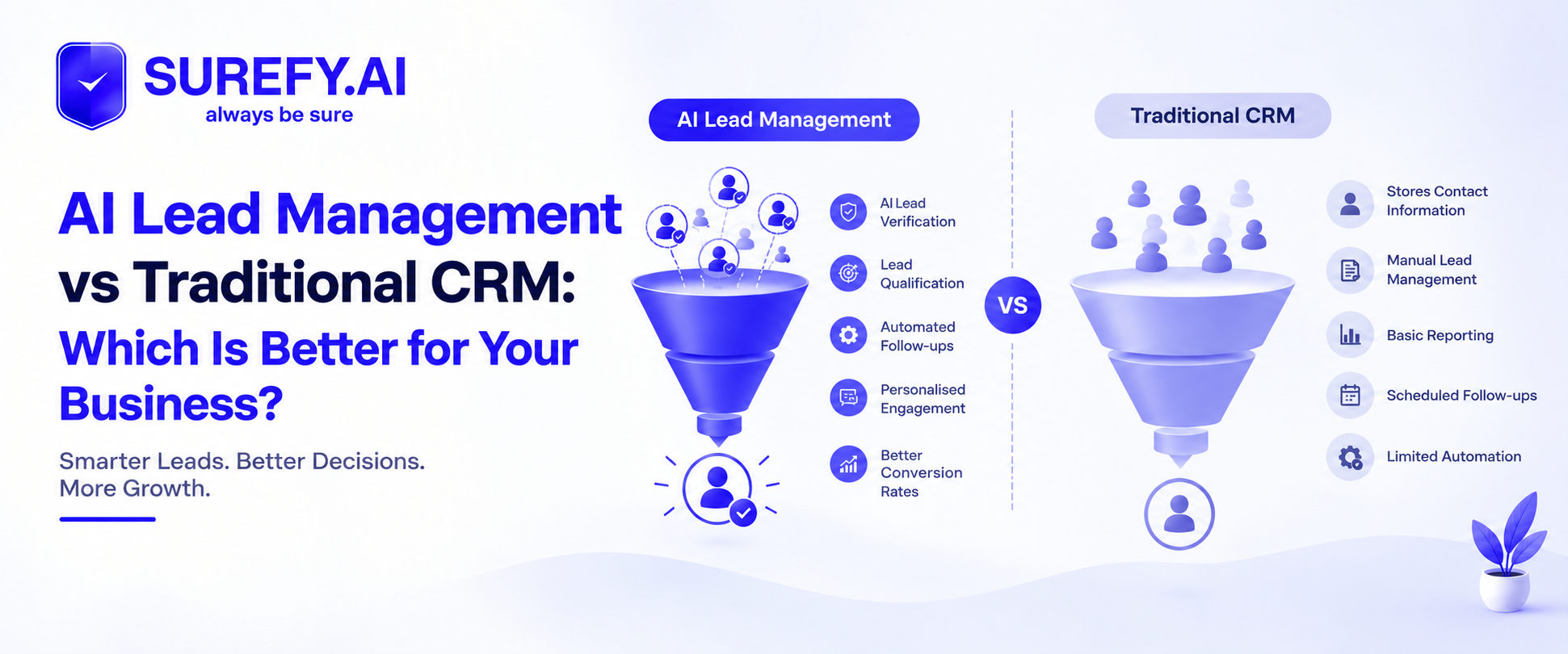
The biggest difference is the level of automation and intelligence involved.
| Traditional Lead Management | AI Lead Management Platform |
| Manual data handling | Automated data processing |
| Basic lead storage | Intelligent lead management |
| Manual qualification | AI-assisted qualification |
| Manual follow-ups | Automated follow-up workflows |
| Basic reporting | Advanced analytics |
| Limited personalization | Data-driven personalization |
| Manual lead prioritization | AI-assisted prioritization |
| Separate tools | Connected workflows |
| Reactive process | Proactive engagement |
Traditional systems can still be useful for basic CRM activities. However, businesses handling large lead volumes may benefit from more automated processes.
What Is AI Lead Verification?
AI Lead Verification refers to using automated technologies and intelligent rules to evaluate whether lead information is accurate, complete, and usable.
For example, a lead verification workflow may check:
- Phone number validity
- Email validity
- Duplicate records
- Required fields
- Business information
- Customer information
- Data consistency
The purpose is not simply to collect more leads but to improve the quality and usability of lead data.
This is particularly important for businesses running large-scale digital marketing campaigns.
What Is Verified Lead Generation?
Verified Lead Generation combines lead acquisition with lead validation.
Instead of treating every submitted form or contact record equally, businesses can introduce verification and qualification steps before passing leads to sales teams.
A simplified workflow could look like:
Lead Generation → Lead Capture → Lead Verification → Lead Qualification → Lead Prioritization → Sales Engagement → Conversion
This approach can help businesses reduce the amount of time sales teams spend dealing with incomplete, duplicate, or irrelevant lead records.
Role of a Customer Verification Platform
An AI-powered lead management system can also work alongside a Customer Verification Platform.
Customer verification can help businesses validate customer information before initiating certain sales, onboarding, or service processes.
Depending on the business use case, verification may involve:
- Customer identity information
- Contact information
- Business information
- Customer records
- Digital verification processes
- API-based verification
For organizations handling large customer volumes, automated verification can make data processing more scalable.
Business Verification API and Digital Customer Verification
Businesses increasingly use APIs to connect verification services with their existing applications.
A Business Verification API can allow an application or platform to send information for automated verification and receive the relevant response.
Similarly, Digital Customer Verification can help businesses integrate customer validation into online workflows.
For example:
Website → Customer Data → Verification API → Validation Result → Lead Management System
This type of integration can reduce the need for repetitive manual verification.
Customer Data Validation
Good lead management depends heavily on good data.
If the underlying customer information is inaccurate, even sophisticated marketing automation may produce poor results.
Customer Data Validation can help businesses identify issues such as:
- Missing information
- Invalid contact details
- Duplicate records
- Inconsistent data
- Outdated information
Clean and validated data can improve the reliability of reporting, segmentation, targeting, and customer engagement.
AI Sales Automation and Lead Management
Lead management doesn’t stop after qualification.
Once a lead has been identified as potentially valuable, sales teams need to engage with the prospect.
AI Sales Automation can support activities such as:
- Automated lead assignment
- Follow-up reminders
- Customer segmentation
- Lead prioritization
- Communication workflows
- Sales notifications
- Engagement tracking
Automation can help sales teams reduce repetitive administrative work while maintaining a structured follow-up process.
How AI Lead Management Supports Customer Engagement
Lead management and customer engagement are closely connected.
Once a prospect enters the system, businesses can use customer information and engagement history to create more relevant communication.
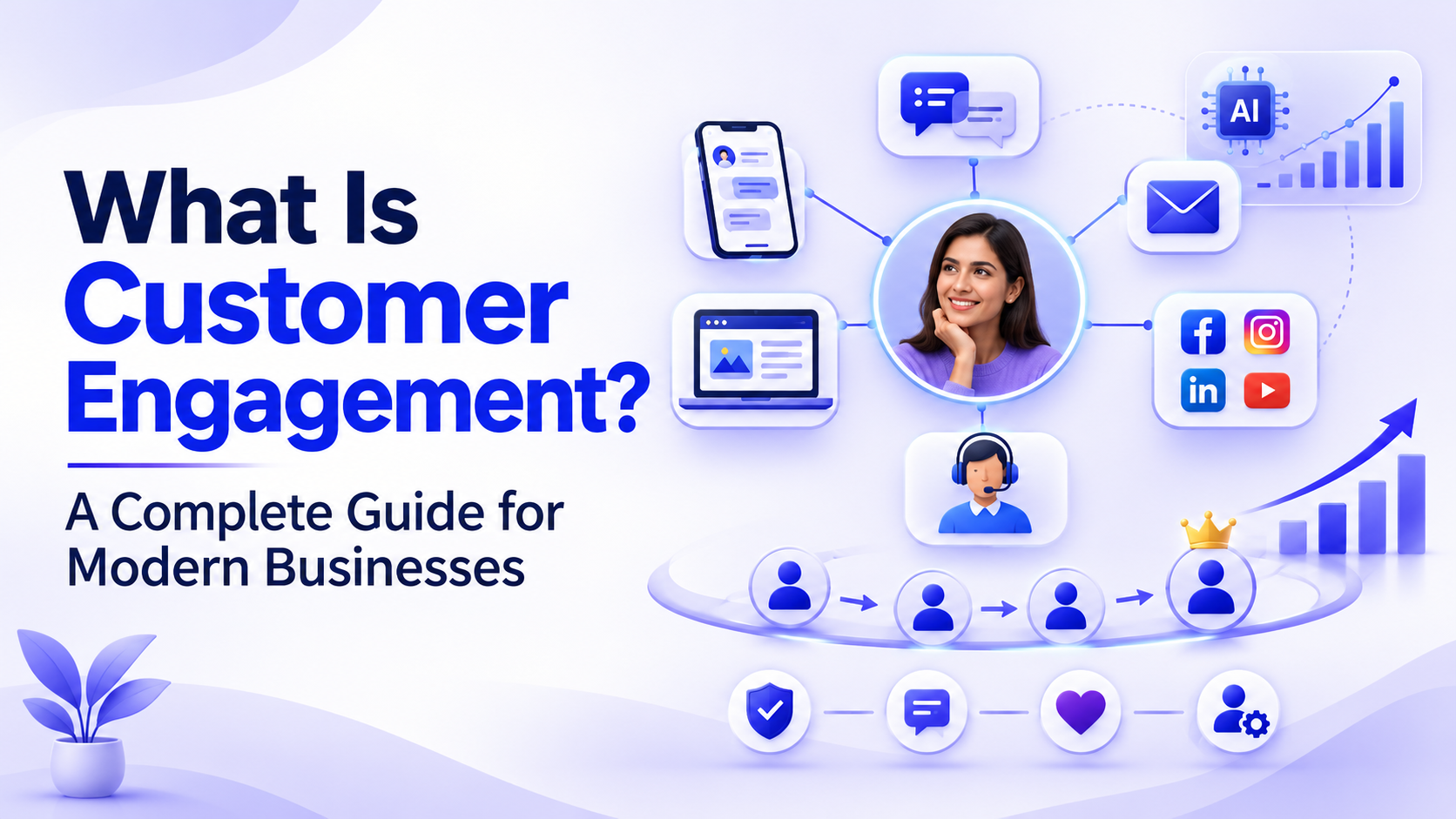
A Customer Engagement Platform can help businesses manage interactions across channels such as:
- SMS
- Voice
- Web forms
- Campaigns
For example, a prospect who has shown interest in a specific product could receive communication related to that product rather than a generic marketing message.
This creates a more contextual customer journey.
Campaign Management Software and AI Lead Management
Marketing teams often run several campaigns simultaneously.
Campaign Management Software can help businesses organize and track campaign-based lead activity.
An integrated workflow could look like:
Campaign → Lead Generation → Lead Capture → Verification → Qualification → Engagement → Conversion
This makes it easier to understand which campaigns generate leads and which generate leads that meet the organization’s qualification criteria.
AI Marketing Platform for Lead Management
An AI Marketing Platform can connect marketing activities with customer and lead data.
For example, businesses can use AI-powered workflows for:
- Audience segmentation
- Lead identification
- Campaign management
- Lead scoring
- Customer engagement
- Follow-up automation
- Performance analysis
The objective is to create a more connected marketing-to-sales process.
AI Lead Management Platform for Different Businesses
An AI Lead Management Platform can be useful across different industries.
Real Estate
Real estate companies can manage enquiries based on:
- Location
- Property type
- Budget
- Buyer intent
- Lead source
Education
Educational institutions can manage enquiries based on:
- Course interest
- Location
- Eligibility
- Admission timeline
Financial Services
Businesses can organize prospects based on:
- Product interest
- Customer profile
- Application information
- Verification requirements
Healthcare
Organizations can manage enquiries, appointments, and customer communication while applying appropriate data and privacy controls.
Automotive
Dealerships can categorize prospects according to:
- Vehicle interest
- Budget
- Location
- Purchase timeline
The exact workflow should be adapted to the industry’s requirements and applicable regulations.
Benefits of an AI Lead Management Platform
1. Better Lead Organization
All lead information can be managed through a centralized system.
2. Faster Lead Processing
Automated workflows can reduce repetitive manual tasks.
3. Improved Data Quality
Verification and validation can help identify problematic records.
4. Better Lead Prioritization
AI-assisted scoring can help sales teams determine which leads deserve attention first.
5. Faster Sales Response
Automated routing and notifications can reduce delays.
6. More Consistent Follow-Up
Automated workflows can help ensure that leads don’t get forgotten.
7. Better Marketing and Sales Alignment
Marketing and sales teams can work with a shared lead lifecycle.
8. More Actionable Insights
Analytics can help businesses understand lead sources, engagement, qualification, and conversion patterns.
Key Features to Look for in AI Lead Management Software
Before selecting an AI Lead Management Software solution, businesses should evaluate features such as:
Lead Capture
Ability to collect leads from multiple sources.
Lead Verification
Tools for validating lead information.
Lead Qualification
Rules and AI-assisted workflows for identifying relevant prospects.
Lead Scoring
Ability to prioritize leads based on defined criteria.
Lead Distribution
Automated assignment to appropriate sales representatives.
Customer Engagement
Multi-channel communication capabilities.
Campaign Management
Ability to track campaign-generated leads.
Analytics
Reporting on lead sources, quality, engagement, and outcomes.
API Integration
Ability to connect with existing business applications.
Automation
Workflow automation for repetitive sales and marketing activities.
How to Choose an AI Lead Management Platform
Businesses should consider more than the number of features available.
Evaluate the platform based on:
1. Lead Volume
Can it handle your current and expected lead volume?
2. Integration Requirements
Can it connect with your existing CRM, website, marketing tools, APIs, and communication channels?
3. Verification Capabilities
Does it support your lead and customer verification requirements?
4. Automation
Can repetitive workflows be automated?
5. Reporting
Can your team measure lead quality and campaign performance?
6. Scalability
Can the system support business growth?
7. Security and Compliance
Does the platform provide appropriate controls for the data your organization processes?
AI Lead Management Platform: A Simple Example
Consider a company generating 5,000 leads through digital advertising.
Instead of manually processing every lead, an AI-powered workflow could be:
5,000 Leads Generated
↓
Lead Data Captured
↓
Duplicate & Data Validation
↓
AI Lead Verification
↓
Lead Qualification
↓
Lead Scoring
↓
High-Priority Leads Routed to Sales
↓
Automated Customer Engagement
↓
Sales Follow-Up
↓
Conversion & Retention
This creates a structured journey from initial lead acquisition to customer engagement.
AI Lead Management Is More Than Lead Storage
A modern lead management system should not be viewed simply as a digital address book.
The real value comes from connecting:
Data + Verification + Qualification + Automation + Engagement + Analytics
When these processes work together, businesses can create a more structured approach to lead management.
The goal is not necessarily to generate the maximum number of leads.
The goal is to help businesses identify, understand, prioritize, and engage relevant prospects more efficiently.
Frequently Asked Questions
What is an AI Lead Management Platform?
An AI Lead Management Platform is software that uses artificial intelligence and automation to capture, verify, qualify, prioritize, distribute, and manage leads throughout the sales lifecycle.
How is AI lead management different from CRM?
A CRM primarily focuses on managing customer and prospect relationships and records. AI lead management adds intelligent automation, lead verification, qualification, prioritization, and workflow capabilities to the lead management process.
What is AI Lead Verification?
AI Lead Verification uses automated technologies and validation processes to assess whether lead information is accurate, complete, valid, and usable.
What is verified lead generation?
Verified lead generation combines lead acquisition with lead validation so that businesses can identify potentially usable leads before they are passed to sales teams.
Can AI qualify leads automatically?
Yes. AI-powered systems can evaluate lead information and engagement signals against defined qualification criteria. Human review may still be appropriate for complex or high-value leads.
What is Lead Qualification Software?
Lead Qualification Software helps businesses evaluate prospects based on criteria such as customer profile, location, product interest, engagement, budget, or other business-specific requirements.
Can an AI Lead Management Platform automate follow-ups?
Yes. Depending on the platform, automated workflows can trigger reminders, notifications, messages, campaigns, or other follow-up activities based on predefined conditions.
Why is customer data validation important?
Accurate customer data helps businesses improve lead processing, segmentation, reporting, communication, and sales workflows while reducing problems caused by duplicate or incomplete records.
What is a Customer Verification Platform?
A Customer Verification Platform helps businesses digitally validate customer information as part of onboarding, lead management, sales, or service workflows.
Can AI lead management integrate with other software?
Yes. Many platforms provide APIs or integrations that allow lead management systems to connect with websites, CRMs, communication platforms, marketing systems, verification services, and other business applications.
Final Takeaway
An AI Lead Management Platform combines lead capture, verification, qualification, prioritization, automation, customer engagement, and analytics into a more connected lead management workflow.
For businesses dealing with growing lead volumes, the combination of AI Lead Verification, Lead Qualification Software, Verified Lead Generation, Customer Data Validation, AI Sales Automation, and Customer Engagement can help create a more structured path from prospect acquisition to conversion.
The most important shift is from simply asking “How many leads did we generate?” to also asking:
“How many usable leads did we identify, how quickly did we engage them, and how effectively did we move them through the customer journey?”