


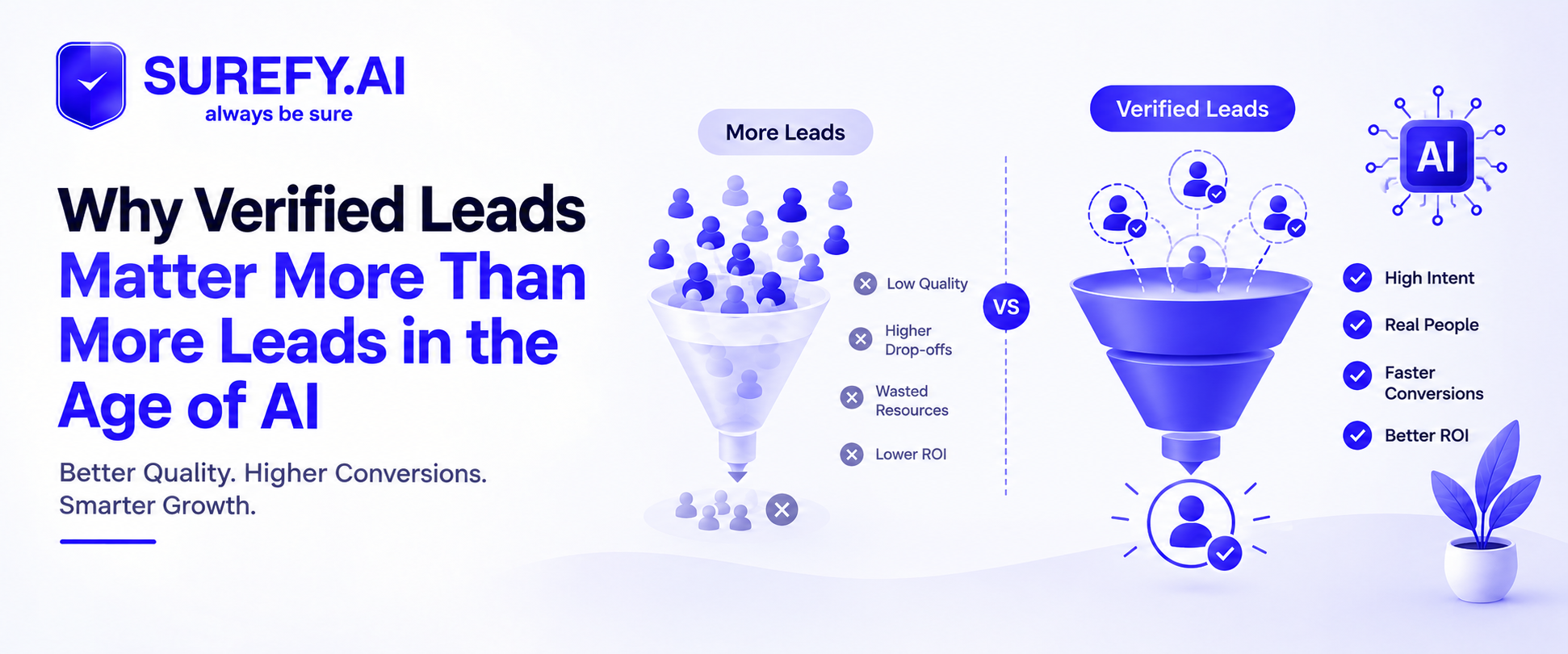
In today’s competitive digital landscape, businesses are constantly looking for ways to generate more leads, increase sales and grow revenue. From paid advertising and social media campaigns to email marketing and website forms, companies invest significant time and money in attracting potential customers.
But there is one important question every business should ask: Are more leads actually bringing more business?
A database filled with thousands of contacts may look impressive, but if many of those contacts have incorrect details, little buying interest or no genuine need for your product, the sales team may spend more time chasing prospects than closing deals.
This is where verified lead generation becomes essential.
In the age of artificial intelligence, successful marketing is no longer just about generating a high volume of leads. It is about identifying genuine prospects, validating customer information, understanding buying intent and helping sales teams focus on the right opportunities.
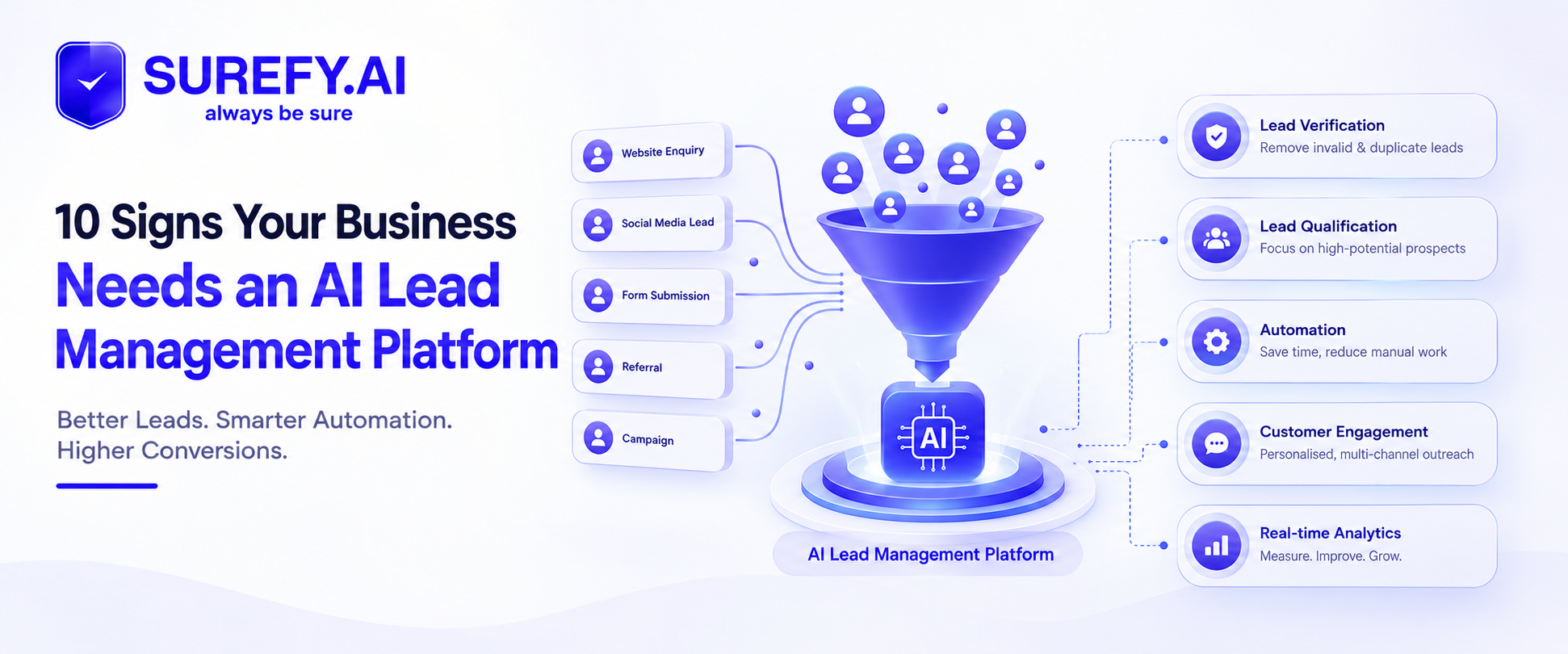
An AI Lead Management Platform can help businesses bring these activities together, making lead verification, qualification, prioritisation and follow-up more organised and efficient.
Let’s explore why verified leads matter, how AI is transforming lead management and what businesses can do to improve lead quality.
What is Verified Lead Generation?
Verified lead generation is the process of identifying potential customers and checking whether their available contact information and relevant details are accurate, usable and appropriate for further engagement.
Depending on the business and its industry, verification may include checking phone numbers, email addresses, business details, duplicate records and other relevant information.
However, it is important to understand that a verified contact is not automatically a qualified buyer.
For example, a phone number may be active, but the person associated with it may have no interest in the product. Similarly, a genuine business contact may not have the budget or authority to make a purchase.
That is why effective lead management combines verification with qualification.
- Lead verification: Checks whether contact and business information is reliable.
- Lead qualification: Evaluates whether the prospect matches your target customer profile and has a relevant need.
- Lead prioritisation: Helps determine which prospects deserve attention first.
- Lead nurturing: Builds relationships with prospects who need more time before making a decision.
When these processes work together, businesses can create a more dependable sales pipeline rather than simply increasing the number of contacts in their database.
Why More Leads Do Not Always Mean More Sales
Generating more leads can increase the number of potential opportunities, but it does not guarantee more revenue.
Imagine a company receives 1,000 leads through a marketing campaign. Many contacts may be duplicated, some may have incorrect details, and others may not be interested in the offering.
The sales team still needs to review those records, attempt contact, identify genuine opportunities and follow up with relevant prospects.
If the quality of incoming leads is poor, the team may spend valuable time on contacts that are unlikely to convert.
Common problems associated with low-quality leads include:
- Incorrect or outdated contact information.
- Duplicate records across marketing channels.
- Prospects who do not match the ideal customer profile.
- Low engagement and limited buying intent.
- Delayed follow-ups because sales teams are overwhelmed.
- Marketing budgets spent attracting contacts who never become customers.
- Inaccurate campaign performance reports.
The solution is not necessarily to stop generating more leads. Instead, businesses should balance lead volume with lead quality.
A smaller pool of relevant, reachable and well-qualified prospects can be more useful than a much larger database that requires extensive manual checking.
5 Reasons Verified Leads Matter More in the Age of AI
1. They Help Sales Teams Focus on Genuine Opportunities
Sales representatives have limited time. Every unnecessary call, repeated follow-up or manual data check takes attention away from promising prospects.
Verified lead generation helps teams begin with more reliable information. When verification is combined with lead qualification, sales representatives can focus on prospects who match the company’s requirements and have demonstrated relevant interest.
Lead Qualification Software can support this process by applying predefined criteria, assigning lead scores and helping teams organise their sales pipeline.
For example, a B2B software company may prioritise prospects based on company size, industry, business requirements, decision-making authority and interest in a product demonstration.
This gives the sales team a clearer starting point and reduces dependence on guesswork.
2. AI Makes Lead Verification and Prioritisation More Scalable
Manually checking every lead becomes difficult as a business grows.
An AI Lead Verification Platform can help automate selected data checks, identify inconsistencies, flag potential duplicates and organise records for further review. The specific checks available depend on the platform and its integrations.
AI can also analyse permitted customer interactions and historical sales patterns to help identify promising prospects.
For example, a business may use AI to prioritise a lead who has requested a demo and matches its ideal customer profile over a contact who has only visited a general information page.
An AI Lead Management Platform can bring these signals into a more structured workflow, helping teams decide which leads need immediate attention and which should enter a nurturing sequence.
AI recommendations should still be reviewed against business rules, data quality and actual sales outcomes.
3. Better Data Can Improve Marketing Decisions
Marketing teams often compare campaigns using impressions, clicks, form submissions and the total number of leads generated.
These metrics are useful, but they do not tell the complete story.
A campaign that generates 500 leads may produce fewer sales opportunities than another campaign that generates only 150 leads. Without tracking lead quality and downstream conversions, marketers may continue investing in campaigns that produce volume rather than business value.
Customer Data Validation helps businesses identify incomplete, inconsistent or duplicated information before it creates problems in reporting and follow-up.
By connecting lead quality with campaign performance, teams can better understand which channels attract relevant prospects and which require improvement.
A strong measurement framework should track metrics such as:
- Percentage of leads with valid contact information.
- Lead-to-qualified-lead conversion rate.
- Qualified-lead-to-opportunity conversion rate.
- Sales conversion rate.
- Cost per qualified lead.
- Revenue generated by marketing channel.
These measures offer a more meaningful view of marketing effectiveness than lead volume alone.
4. Verified Data Supports More Relevant Customer Engagement
Customers expect communication to be relevant to their needs. Repeated messages, incorrect personalisation and irrelevant sales calls can damage trust.
A Customer Engagement Platform can help businesses organise communication across supported channels and coordinate follow-ups based on customer preferences and interactions.
For example, a prospect who requests pricing information may need a timely sales conversation, while someone who downloads an educational guide may benefit from informative follow-up content.
A Marketing Automation Platform can help schedule these communications, manage nurturing journeys and trigger follow-ups when specific conditions are met.
When connected with reliable lead information, automation becomes more useful because messages can be directed towards the right audience with more relevant context.
Businesses should also respect consent, communication preferences and applicable data protection requirements when collecting and using customer information.
5. They Can Help Businesses Make Better Use of Sales and Marketing Budgets
Every lead has an acquisition cost, whether it comes from paid advertising, organic search, referrals, events or outbound campaigns.
When a significant share of incoming leads is unusable or poorly qualified, the effective cost of acquiring a genuine opportunity increases.
Verified lead generation helps businesses evaluate the quality of their acquisition efforts instead of focusing exclusively on the number of contacts collected.
Consider a campaign that generates 200 leads at a total cost of ₹20,000. If 40 become qualified leads, the cost per qualified lead is ₹500.
If another campaign generates 100 leads at the same cost and 50 become qualified, its cost per qualified lead is ₹400.
In this illustrative example, the second campaign generates fewer leads but produces qualified leads at a lower cost.
This does not guarantee that every qualified lead will become a customer. Businesses should also evaluate opportunity value, closing rates and revenue before deciding which campaign performs best.
How an AI Lead Management Platform Improves Lead Quality
An AI Lead Management Platform can connect different stages of the lead lifecycle, from initial capture to qualification, engagement and conversion.
Here is how the process can work.
Step 1: Capture Leads from Relevant Channels
Leads may enter a business through website forms, landing pages, social media, advertising campaigns, phone enquiries or other permitted sources.
AI Lead Generation Software can help businesses identify potential prospects, support prospect research and streamline lead capture, depending on the platform’s capabilities.
The objective is to create a consistent process for collecting leads and recording where they originated.
Step 2: Verify Contact and Business Information
Once a lead enters the system, verification checks can help assess the accuracy and usability of available information.
Lead Verification Software may support email validation, phone-number checks, duplicate detection or business data checks through integrated services.
A Business Verification API can provide a way for applications to request business verification data from an external service, where available and legally appropriate.
Similarly, a Customer Verification Platform may support identity or customer information checks as part of a defined onboarding or verification process.
The verification method should match the business requirement. A simple marketing contact check is different from formal identity verification or regulated KYC.
Step 3: Qualify and Score the Leads
After verification, leads can be evaluated against an ideal customer profile.
Criteria may include industry, company size, product requirements, engagement history, purchasing authority and estimated buying timeline.
Lead Qualification Software can help apply these criteria consistently. AI-based scoring may also identify patterns associated with successful conversions when sufficient, relevant historical data is available.
Sales teams should periodically review the scoring model to ensure it reflects actual business outcomes.
Step 4: Prioritise Leads for Follow-Up
Not every lead requires the same level of attention.
A prospect requesting a sales consultation may need immediate follow-up, while an early-stage researcher may be better suited to an educational email sequence.
An AI Lead Management Platform can help organise leads by priority, assign them to the appropriate team and create reminders for follow-up.
This makes it easier for businesses to coordinate their sales pipeline and avoid overlooking promising opportunities.
Step 5: Engage Prospects Through Relevant Campaigns
Once leads have been segmented, businesses can use Campaign Management Software to coordinate communication and measure campaign activity.
A Marketing Automation Platform can help execute planned email journeys, reminders and other supported communications. A Customer Engagement Platform can help maintain consistent interactions across the customer journey.
These tools work best when communication is based on relevant customer information, clear objectives and appropriate consent.
Step 6: Measure Conversions and Improve the Process
The final step is to understand which leads progress through the sales funnel and why.
Businesses should compare lead sources, qualification rates, sales outcomes and acquisition costs.
These insights can help refine targeting, improve verification rules and update lead-scoring criteria over time.
An effective lead management process is not a one-time setup. It requires regular measurement and improvement.
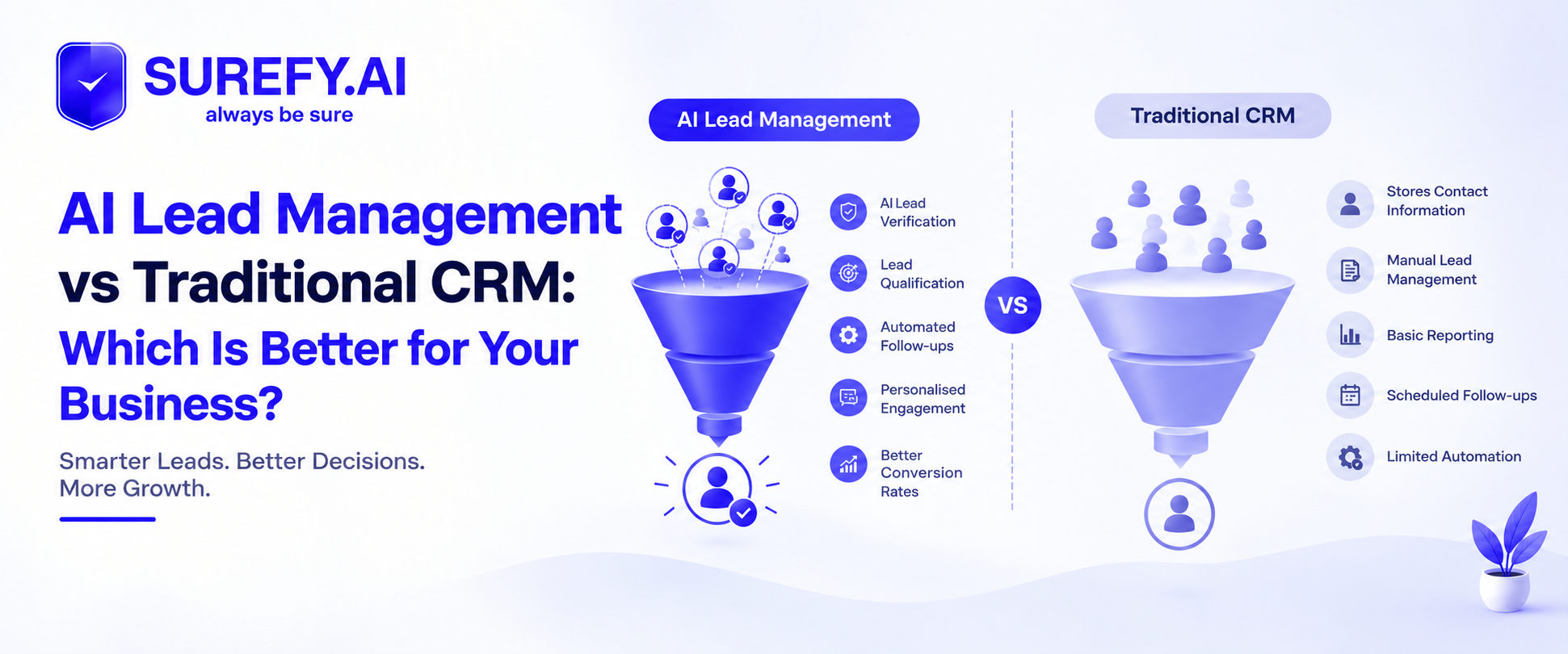
AI Lead Verification vs. Traditional Lead Management
Traditional lead management often relies on manual checks, spreadsheets, separate communication tools and individual sales representatives to assess lead quality.
AI-supported lead management can automate selected tasks and help teams identify patterns across larger datasets.
| Activity | Traditional approach | AI-supported approach |
|---|---|---|
| Data checks | Manual or rule-based checks | Automated checks where supported |
| Duplicate detection | Manual review or basic rules | Automated matching and duplicate flags |
| Lead scoring | Fixed criteria and manual assessment | Rules combined with predictive scoring, where available |
| Prioritisation | Sales representative judgement | Scoring, engagement signals and defined rules |
| Follow-up | Manual reminders and scheduling | Automated workflows and reminders |
| Reporting | Periodic manual analysis | More frequent reporting and pattern analysis |
AI does not eliminate the need for human judgement. Inaccurate source data, poorly designed rules and unsuitable models can still lead to incorrect decisions.
The most effective approach combines automation with clear qualification criteria, appropriate oversight and reliable data practices.
The Role of Digital Customer Verification in Lead Management
Digital Customer Verification helps businesses validate relevant customer information through digital processes rather than relying entirely on manual checks.
Depending on the service and use case, this may involve validating contact details, matching records, checking business information or conducting identity verification.
A Customer Data Verification Platform can help centralise selected checks and reduce inconsistent processes across different customer touchpoints.
For businesses operating in sectors where formal identity verification or KYC obligations apply, the verification process must follow the relevant legal and regulatory requirements. A standard lead verification tool should not be treated as a substitute for a compliant KYC solution.
Similarly, a Business Verification API may help organisations retrieve or validate business information, but the accuracy and scope of results depend on the provider, data sources and verification method.
The goal is to establish a dependable information foundation before using customer data for sales decisions or personalised engagement.
How AI Sales Automation Connects Verified Leads to Revenue
Verification improves confidence in the data, while qualification helps determine whether a prospect is worth pursuing. AI Sales Automation connects these activities with the next steps in the sales process.
Depending on the platform, automation may help with:
- Assigning leads to the appropriate sales representatives.
- Triggering follow-up reminders.
- Recording customer interactions.
- Scheduling communication sequences.
- Prioritising leads based on predefined signals.
- Identifying leads that need additional nurturing.
- Monitoring progress from lead capture to conversion.
For example, a lead that passes contact checks, matches the target customer profile and requests a product demonstration may be routed to the sales team.
A lead with incomplete information may be flagged for review, while a relevant but early-stage prospect may receive educational content.
This creates a more organised connection between marketing activities and sales follow-up.
AI Sales Automation should support meaningful customer interactions rather than simply increasing the number of automated messages sent.
How to Choose the Right AI Lead Management Platform
Before selecting an AI Lead Management Platform, businesses should evaluate their existing lead generation and sales processes.
The right solution depends on company size, industry, data requirements, communication channels and integration needs.
Consider these factors:
1. Lead verification capabilities: Check which contact, duplicate and business data checks the platform supports.
2. Qualification and scoring: Look for flexible criteria that reflect your ideal customer profile and sales process.
3. Integration options: Confirm whether the platform can connect with your CRM, website, marketing tools and other relevant systems.
4. Customer engagement: Evaluate whether it supports the communication channels your business actually uses.
5. Campaign automation: Check whether workflows, segmentation, follow-up reminders and reporting fit your requirements.
6. Analytics and reporting: Ensure you can measure qualified leads, conversion rates, acquisition costs and revenue outcomes.
7. Privacy and security: Review access controls, data handling practices, retention policies and compliance requirements.
8. Scalability and usability: Choose a system your team can use consistently as lead volume and business needs grow.
Some businesses may require a dedicated verification solution, while others may benefit from a more integrated AI Marketing Platform that combines lead management, customer engagement and automation.
The best choice is the one that addresses your actual workflow gaps and produces measurable improvements.
Why Verified Lead Generation Is Important for Growing Indian Businesses
For Indian MSMEs, startups and growing enterprises, sales and marketing resources are often limited. Teams may handle leads from multiple cities, advertising platforms, website enquiries and messaging channels simultaneously.
When these leads are not organised or checked consistently, follow-ups can become difficult to manage.
A verified lead generation process helps businesses establish clearer data standards, identify relevant prospects and measure campaign quality more effectively.
An integrated AI Lead Management Platform can support these efforts by connecting lead capture, verification, qualification and follow-up workflows.
For example, a B2B service provider can prioritise enquiries from businesses that match its target industry and requirements. A financial services company may need additional verification procedures appropriate to its regulatory obligations. An education business may focus on accurate contact information, course interest and enrolment intent.
The specific process varies by industry, but the underlying principle remains the same: lead quality should be measured by how well prospects fit the business and progress towards meaningful outcomes.
How Surefy.ai Can Support a Quality-First Lead Strategy
Businesses looking to improve lead management can benefit from a connected approach to lead data, customer communication and automation.
Surefy.ai offers services across areas such as AI Lead Management, Customer Engagement, Lead Verification, KYC APIs, WhatsApp Business API, Voice and SMS Campaigns, Analytics and AI Automation.
These capabilities align with important stages of a quality-focused lead management strategy: collecting and checking information, organising follow-ups, engaging customers and monitoring campaign performance.
Depending on the specific product configuration and integration, businesses can evaluate how these capabilities fit into their existing sales and marketing workflows.
Rather than measuring success only by the number of leads generated, businesses should also examine the quality of incoming data, the percentage of qualified prospects, follow-up efficiency and eventual sales outcomes.
The goal is not simply to generate more leads. It is to make every lead management decision more informed, consistent and useful.
Explore Surefy.ai to learn more about its lead management, customer engagement and automation solutions.
Conclusion: Prioritise Lead Quality Over Lead Volume
In the age of AI, generating a large number of leads is only one part of the growth equation. Businesses also need reliable information, effective qualification, timely engagement and clear performance measurement.
Verified lead generation helps establish a stronger starting point. AI Lead Verification can support selected data checks, while lead qualification helps identify prospects that fit the business. AI Sales Automation and campaign management can then help teams follow up consistently and measure outcomes.
However, verification alone cannot guarantee a sale. Genuine interest, product suitability, customer experience, pricing and sales execution all influence conversion.
Businesses that combine lead quality with relevant engagement and continuous optimisation can build a more dependable sales process.
The real competitive advantage is not having the biggest lead database. It is knowing which leads deserve attention, why they matter and how to engage them effectively.
If your business wants to improve its lead management process, explore how Surefy.ai’s solutions can support a more organised and data-driven approach to customer acquisition.
Frequently Asked Questions (FAQs)
1. What is verified lead generation?
Verified lead generation involves collecting potential customer information and checking its accuracy, usability and relevance before further engagement. It may include contact validation, duplicate detection and business data checks.
2. Why are verified leads better than a high volume of leads?
Verified leads can reduce the time spent handling incorrect or duplicate records. When combined with qualification, they help sales teams focus on prospects that match their target customer profile and show relevant buying interest.
3. What is an AI Lead Management Platform?
An AI Lead Management Platform is a system that helps businesses organise and manage leads using automation and, where supported, AI-driven analysis. Capabilities may include lead capture, scoring, qualification, prioritisation, follow-up and reporting.
4. How does AI Lead Verification work?
AI Lead Verification may combine data validation rules, automated checks, pattern recognition and connected verification services to flag inaccurate, incomplete or potentially duplicate records. Its capabilities depend on the platform and available data sources.
5. What is the difference between lead verification and lead qualification?
Lead verification checks whether information is accurate and usable. Lead qualification evaluates whether a prospect is a suitable potential customer based on factors such as business needs, budget, authority, company profile and buying intent.
6. Can verified leads guarantee higher sales conversions?
No. Verified information can improve the starting quality of a sales process, but it cannot guarantee that a prospect will buy. Product suitability, timing, pricing, trust and sales execution also influence conversion.
7. How does a Customer Engagement Platform help with lead conversion?
A Customer Engagement Platform helps businesses coordinate customer interactions across supported channels. When connected with reliable lead data, it can support relevant communication, follow-ups and nurturing throughout the buying journey.
8. What is the role of Lead Qualification Software?
Lead Qualification Software helps businesses evaluate prospects against predefined criteria. Depending on the solution, it may support lead scoring, segmentation, prioritisation and routing to the appropriate sales team.
9. What is the difference between an AI Marketing Platform and a Marketing Automation Platform?
An AI Marketing Platform may use AI to support analysis, targeting, personalisation and marketing decisions. A Marketing Automation Platform focuses on automating defined marketing workflows, such as scheduled campaigns, audience segmentation and follow-up sequences. Some platforms offer both sets of capabilities.
10. How can Indian MSMEs improve lead quality?
Indian MSMEs can improve lead quality by defining their ideal customer profile, collecting relevant information, validating contact details, removing duplicates, qualifying prospects, following up promptly and tracking conversion rates by lead source.
11. What is a Business Verification API?
A Business Verification API allows an application to request business-related verification information from an external service. Available checks and results depend on the provider, data sources and applicable requirements.
12. Is a Customer Verification Platform the same as a KYC solution?
Not necessarily. A Customer Verification Platform may support different forms of data or identity verification. A KYC solution addresses specific customer due diligence requirements and must be suitable for the applicable regulatory framework. Businesses should verify the exact capabilities and compliance scope before implementation.